HEPA Filter Grades Explained: H10, H11, H12, H13 and H14—Which Do You Need?
11-05-2026
In the critical environments of pharmaceutical manufacturing, high-tech laboratories, and specialized healthcare facilities, air purity is not a luxury—it is a regulatory mandate. At the center of this protection is the hepa filter. However, the term "HEPA" is often used as a blanket statement, despite the fact that filtration efficiency varies significantly across different grades.
Choosing the wrong grade can lead to two expensive failures: either your facility fails an ISO audit due to insufficient filtration, or you over-specify your HEPA Filter for HVAC System, leading to astronomical energy costs and motor strain. As a premier Cleanroom Air Filter Manufacturer, Rayshen provides this exhaustive guide to help you navigate the spectrum from H10 to H14 and determine exactly which grade your project requires.
1. Understanding the EN 1822 Standard for HEPA Filters
Before diving into specific grades, it is essential to understand the governing standard. In 2026, the European Standard EN 1822 remains the global benchmark for classifying high-efficiency air filters. This standard classifies filters based on their performance at the Most Penetrating Particle Size (MPPS), which is typically between 0.1 and 0.3 microns.
While a lower-grade filter might catch 100% of large dust particles, a true Pharmaceutical Grade Air Filter is judged by its ability to catch the most elusive, microscopic particles that "slip" through standard media.
2. The EPA Grades: H10, H11, and H12 (Semi-HEPA)
Technically categorized as "Efficient Particulate Air" (EPA) filters, these grades are often referred to as "Semi-HEPA."
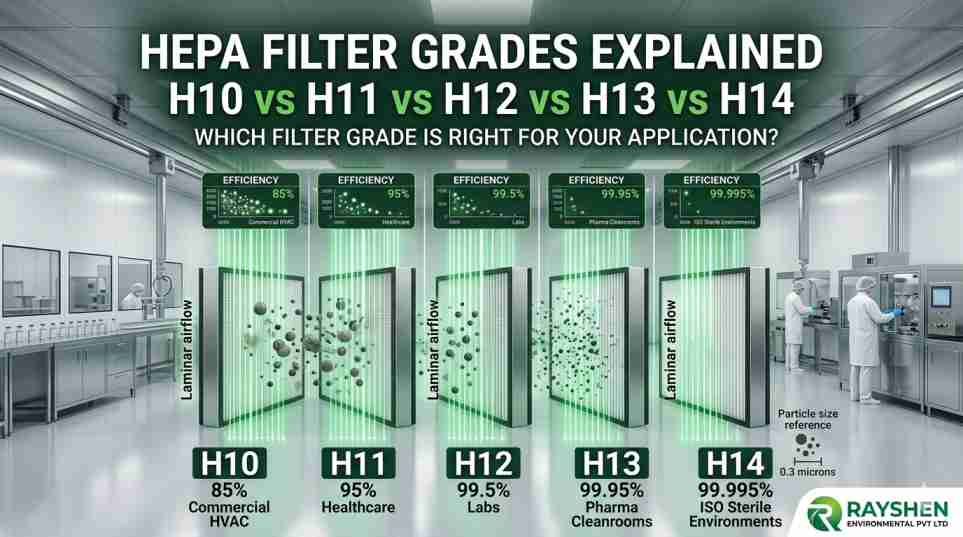
- H10 (E10): Offers 85% efficiency at MPPS.
- H11 (E11): Offers 95% efficiency at MPPS.
- H12 (E12): Offers 99.5% efficiency at MPPS.
While these are excellent for high-end residential use or as pre-filters in a Deep Pleat HEPA Filter India industrial setup, they do not meet the stringent requirements for sterile cleanroom environments. If your facility requires ISO Class 5 or Class 6 certification, these grades will not suffice.
3. The Professional Standard: The H13 HEPA Filter
The H13 grade is the entry point for true high-efficiency filtration. With a 99.95% efficiency rating at MPPS, it is widely used in hospital operating rooms, high-end commercial HVAC systems, and electronics assembly.
H13 vs H14 HEPA Filter: The Crucial Gap
Many facility managers ask why they should pay more for h14 when H13 is already 99.95% efficient. The answer lies in the penetration rate.
H13 allows 50 particles per 100,000 to pass.
H14 allows only 5 particles per 100,000 to pass.
When you are manufacturing sterile injectables or conducting sensitive gene research, that 10x difference in particle penetration is the difference between safety and contamination.
4. The Pharmaceutical Gold Standard: HEPA Filter H14
For any Pharmaceutical Grade Air Filter application, the HEPA Filter H14 is the non-negotiable requirement. With an efficiency of 99.995% at MPPS, it provides the ultra-pure air necessary for "Grade A" zones.
Why H14 is Mandatory for ISO 5
Maintaining an ISO Class 5 cleanroom requires almost zero particulate presence. The HEPA Filter H14 ensures that the air exiting the fan filter unit (FFU) is virtually sterile. As a leading Cleanroom Air Filter Manufacturer, Rayshen subjects every H14 unit to a rigorous "Scan Test" to ensure there are no pinhole leaks in the filter media or the frame seal.
5. Physical Configurations: Mini Pleat vs. Deep Pleat
The grade of the filter (H13 or H14) tells you how efficient it is, but the pleat design tells you how it will perform within your specific HEPA Filter for HVAC System.
The Mini Pleat HEPA Filter
The Mini Pleat HEPA Filter is the modern standard for modular cleanrooms.
Design: These use thermoplastic beads to separate the folds of the glass fiber media.
Performance: This design offers a much larger surface area in a slim profile, leading to a lower "Initial Pressure Drop." For facilities focusing on energy efficiency, the mini-pleat is the superior choice.
Deep Pleat HEPA Filter India Standard
The Deep Pleat HEPA Filter India standard is a rugged alternative for heavy-duty industrial applications.
Design: These utilize corrugated aluminum separators and can be up to 12 inches deep.
Performance: They are designed to handle massive air volumes (up to 3000 CMH) in primary air handling units (AHUs). They are the "workhorses" of the Indian HVAC industry.
6. Engineering Considerations for Your HVAC System
Integrating a high-grade hepa filter into an existing HVAC system is not a simple "plug-and-play" task.
Static Pressure and Fan Capacity
An H14 filter is significantly denser than an H13 or H11 filter. This density creates higher resistance (static pressure). If your HEPA Filter for HVAC System does not have a fan motor capable of overcoming this resistance, your airflow velocity will drop below the required 0.45 m/s, causing your cleanroom to lose its positive pressure and fail validation.
The Importance of Pre-Filtration
To protect your investment in an expensive HEPA Filter H14, you must implement a multi-stage filtration strategy. Using G4 and F9 grade filters as "sacrificial" layers will ensure that your HEPA filter only deals with sub-micron particles, extending its life from 12 months to over 3 years.
7. Quality Assurance: Why Sourcing Matters
When you source from a specialized Cleanroom Air Filter Manufacturer like Rayshen, you are buying more than just a filter; you are buying a certificate of compliance.
DOP/PAO Testing: We verify that every H14 filter is leak-free.
Factory Calibration: Our filters are tested for pressure drop and airflow volume before they leave our facility.
Customization: Whether you need a specific frame depth for a legacy AHU or a high-temperature resistant media, we provide custom-engineered solutions for the most demanding environments.
8. Conclusion: Which Grade Do You Actually Need?
The choice between H13, h14, or lower grades ultimately depends on your "Criticality Zone."
General Healthcare/Commercial: H13 is usually sufficient.
Pharmaceutical Grade A/B Zones: Only HEPA Filter H14 will meet GMP standards.
Industrial Exhaust/Pre-filtration: A Deep Pleat HEPA Filter India standard (H11 or H12) is the most cost-effective solution.
At Rayshen, we don't just supply filters; we provide air integrity solutions. By understanding the technical nuances of each grade and pleat design, you can ensure that your facility is both safe and cost-efficient.
[Contact Rayshen’s Technical Team for an H14 Efficiency Audit] [Download our Technical Datasheet on Mini Pleat vs. Deep Pleat HEPA Filters]
Frequently Asked Questions (FAQs)
1. What is the difference between an H13 and H14 HEPA filter?
The main difference is the efficiency and penetration rate. An H13 HEPA filter captures 99.95% of particles at the Most Penetrating Particle Size (MPPS), while a HEPA filter H14 captures 99.995%. In a H13 vs H14 HEPA filter comparison, the H14 is ten times more efficient at stopping microscopic contaminants, making it the essential grade for sterile pharmaceutical manufacturing.
2. Why is H14 considered a Pharmaceutical Grade Air Filter?
The h14 grade is considered pharmaceutical grade because it meets the strict requirements for ISO Class 5 (Class 100) and Grade A cleanroom zones. These environments require air to be virtually free of sub-micron particles and microbes. As a Cleanroom Air Filter Manufacturer, Rayshen ensures every H14 unit is scan-tested to guarantee zero bypass, which is critical for GMP (Good Manufacturing Practice) compliance.
3. Can I upgrade my HEPA filter for HVAC system from H11 to H14?
Upgrading to a higher grade like h14 requires a technical assessment of your fan’s capacity. Because H14 media is denser, it creates a higher "static pressure" or resistance. If your HEPA filter for HVAC system fans are not powerful enough, the airflow velocity will drop, which can lead to a loss of room pressure and failed air change requirements.
4. What are the benefits of a Mini Pleat HEPA filter over a Deep Pleat?
A Mini Pleat HEPA filter uses thermoplastic beads to separate the folds, allowing for more filter media in a smaller frame. This results in a lower initial pressure drop and significantly higher energy efficiency. Conversely, a Deep Pleat HEPA filter India standard uses aluminum separators and is designed for high-volume air handling units that need to move massive amounts of air (CMH) in industrial settings.
5. How do I choose between H10, H12, and H14 filters?
The choice depends on your "Cleanliness Goal." H10 and H12 filters (EPA grade) are ideal for high-end residential use or as secondary filters in industrial plants. However, for a sterile cleanroom, you must use a HEPA filter H14. Always consult a specialist to balance the cost of the filter against your specific ISO classification requirements.
6. How often should a high-efficiency HEPA filter be replaced?
A Pharmaceutical Grade Air Filter typically lasts between 2 to 5 years, provided it is protected by high-quality pre-filters (G4/F9). You should replace your hepa filter when the pressure drop reaches the "Final Resistance" limit set by the manufacturer or if it fails its mandatory annual leak-detection and validation test.
.png)
.png)