Optimizing Your AHU: How H14 Mini-Pleat Filters Reduce Pressure Drop and Slash Energy Bills
22-04-2026
In the 2026 industrial landscape, the cleanroom is no longer just a space for sterile production; it is a significant financial center where operational efficiency is the new benchmark for success. For pharmaceutical plants and semiconductor fabs, the Air Handling Unit (AHU) is the single largest consumer of electricity, often responsible for over 60% of total facility energy usage.
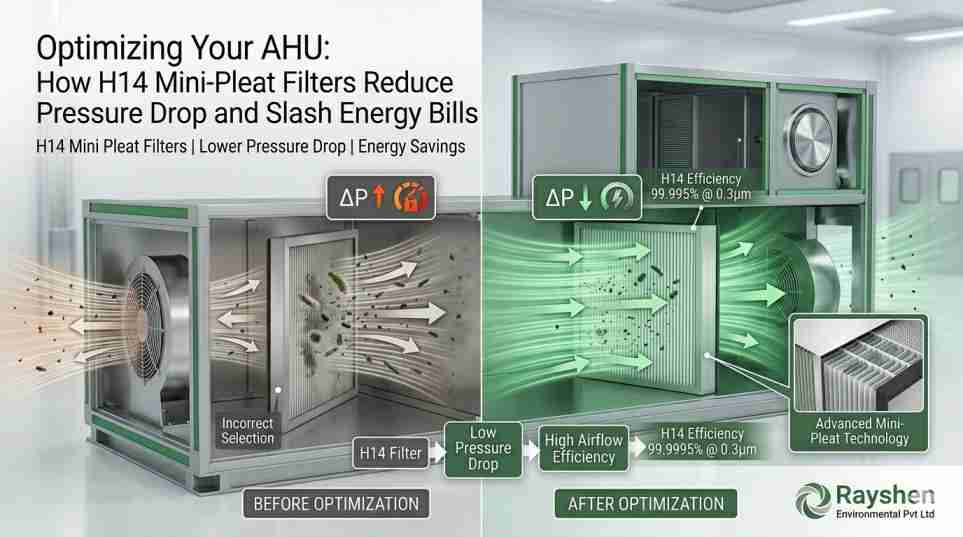
At the core of this consumption is a mechanical challenge: pushing air through the dense media of a HEPA filter. As a leading HEPA filter manufacturer, Rayshen has observed that many facilities are overpaying for their air purity by using outdated filtration geometry. By transitioning to H14 Mini-Pleat HEPA filters, facilities can achieve the gold standard of 99.995% efficiency while drastically lowering the "Pressure Drop" that drains their budget.
1. The Physics of the AHU: Why "Resistance" is Your Greatest Expense
To understand how to save money, we must look at the relationship between the filter and the fan motor. In any AHU, the fan must overcome the Static Pressure of the entire system—ductwork, coils, and filters.
The Exponential Energy Penalty
The energy required to move air is governed by the Fan Laws. If the resistance of your filter bank (Pressure Drop) increases, the power required by the fan motor increases by the cube of the airflow rate.
The Math: A reduction in pressure drop of just 50 Pascals (Pa) can lead to an energy reduction of nearly 20% to 25% for that specific fan unit.
Rayshen’s Innovation: Our H14 Mini-Pleat filters start with an initial resistance as low as 100 Pa to 120 Pa, compared to the 250 Pa often seen in legacy deep-pleat models.
2. Mini-Pleat vs. Deep-Pleat: Engineering the Energy Breakthrough
Why does the "Mini-Pleat" design perform so much better than the traditional "Deep-Pleat" (separator style) filter?
Separator-Free Geometry
Traditional filters use corrugated aluminum separators to keep the filter media apart. While sturdy, these separators take up physical space and create air turbulence.
Rayshen Mini-Pleat Design: We use ultra-thin thermoplastic "hot-melt" beads to separate the pleats. This allows for a compact, zig-zag pattern that packs more filter media into the same frame.
The Result: More surface area means the air moves slower through the media (lower face velocity), which naturally reduces the resistance and the energy needed to push it through.
Elimination of Bypass Leaks
The mini-pleat design offers a seamless, high-density barrier. Because there are no metallic separators that can vibrate or shift, the structural integrity of the pleat pack is superior, ensuring that 100% of the air is filtered with zero bypass.
3. Regulatory Compliance: ISO 14644-16 and the 2026 Sustainability Mandate
In 2026, compliance is no longer just about particle counts (ISO 14644-1). It is about ISO 14644-16, which focuses on Energy Efficiency in Cleanrooms.
The "Green Cleanroom" Movement
Regulatory bodies like the USFDA and EU-GMP are now looking at "Contamination Control Strategy" (CCS) that includes energy resilience.
Specific Fan Power (SFP): Auditors now evaluate how much power (Watts) you use per cubic meter of air moved.
Rayshen’s H14 Filters are designed to help your facility achieve a "Low SFP" rating, making your plant more sustainable and more attractive to international partners who prioritize ESG (Environmental, Social, and Governance) scores.
4. Total Cost of Ownership (TCO): Why Cheap Filters are Expensive
A common mistake in B2B procurement is focusing on the "Sticker Price" of the filter.
| Cost Factor | Low-Cost Deep-Pleat Filter | Rayshen H14 Mini-Pleat |
| Initial Purchase Price | ROI Period | Moderate |
| Initial Pressure Drop | 250 - 280 Pa | 100 - 120 Pa |
| Annual Energy Cost (Estimated) | ₹1,50,000 per AHU | ₹95,000 per AHU |
| Service Life | 12 Months | 18 - 24 Months |
| ROI Period | N/A | 6 - 8 Months |
The Verdict: While a Rayshen H14 filter might have a slightly higher upfront cost, it saves nearly double its own value in electricity costs within the first year alone.
5. Implementation Strategy: How to Optimize Your Existing AHU
You don’t need to replace your entire HVAC system to see these savings. You only need to upgrade the "Lungs" of the system.
Step 1: Baseline Pressure Audit
Before switching, use a calibrated manometer to measure the current pressure drop across your HEPA bank. This provides the data needed to calculate your exact ROI.
Step 2: Retrofitting with Mini-Pleats
Rayshen’s H14 filters are available in all standard frame sizes (e.g., 610x610x69mm). They are "Drop-In" ready for your existing terminal housings or AHU racks.
Step 3: Predictive Maintenance
In 2026, we recommend replacing filters not by "time," but by $\Delta P$ (Delta P). By replacing your H14 filter when it reaches 2.5x its initial resistance, you prevent the fan motor from entering a high-heat, high-wear state, further extending the life of your expensive AHU components.
Conclusion: Turning Air Purity into a Profit Center
In the competitive landscape of 2026, every Pascal of pressure counts. By choosing H14 Mini-Pleat HEPA filters from Rayshen, you are doing more than just protecting your product from 0.3-micron particles—you are optimizing your facility's energy profile, protecting your AHU hardware, and slashing your operational costs.
- Don't let your filters be a drain on your budget.
Explore Other Related Blogs
What Is a HEPA Filter? Types, Uses & High Efficiency Particulate Air Guide- What Is HEPA? A Complete Guide to Meaning, Full Form, Types, Sizes, and Uses
- Clean Room Equipment: The Detailed Guide for Modern Controlled Environments
- H14: The Ultimate Guide to High-Efficiency HEPA Filtration in Modern Cleanrooms
- Air Shower Systems: Advanced Contamination Control for Modern Clean Room Environments
- Ultimate Guide to SS Sink: Sizes, Types, Uses & Cleaning Tips for Commercial Applications
- What Is a Clean Room? A Complete Beginner’s Guide for Modern Industries
6. Frequently Asked Questions (FAQs)
Q1: Does a lower pressure drop mean the filter is less "tight"?
No. Filtration efficiency (99.995%) is a result of the borosilicate glass fiber media quality. Resistance (Pressure Drop) is a result of filter geometry. Rayshen uses premium media to ensure maximum capture with minimum drag.
Q2: Are mini-pleat filters durable enough for high-airflow AHUs?
Absolutely. While they look delicate, our mini-pleats are reinforced with high-strength PU (Polyurethane) sealants and sturdy aluminum or SS 304 frames, making them capable of handling face velocities up to 2.5 m/s without deformation.
Q3: How do these filters perform in humid environments like India?
Rayshen uses moisture-resistant glass fiber. Unlike cheaper paper-based filters, our media does not "swell" or increase in resistance when humidity levels fluctuate, ensuring stable AHU performance year-round.
.png)
.png)