HEPA Filter Efficiency Ratings Explained: H13 vs H14 vs U15 for Cleanrooms
11-05-2026
In the delicate ecosystem of a controlled environment, air is the most volatile variable. For pharmaceutical manufacturers, microelectronics engineers, and healthcare professionals, the ability to intercept microscopic threats is the only barrier between a successful operation and a catastrophic loss. At the center of this defense is the HEPA filter.
However, as filtration technology evolves in 2026, the terminology has become increasingly complex. Facility managers often find themselves navigating a sea of technical jargon: H13, H14, U15, MPPS, and pressure drops. Selecting the wrong grade of Cleanroom Air Filter can lead to one of two expensive mistakes: either compromising the sterility of an ISO Class 5 environment or over-specifying a system and skyrocketing your operational energy costs.
This comprehensive technical analysis breaks down the science of high-efficiency filtration, the critical differences in the H13 vs H14 HEPA filter debate, and why the physical design—whether a Mini Pleat HEPA Filter or a Deep Pleat HEPA Filter—is just as important as the efficiency rating itself.
1. The Physics of Filtration: Understanding the HEPA Standard
To choose the right filter, one must first understand what a HEPA filter actually does. Unlike a simple sieve that catches particles larger than its holes, a high-efficiency filter utilizes a complex web of randomly arranged borosilicate glass fibers.
The MPPS (Most Penetrating Particle Size)
The gold standard for rating a Pharmaceutical Grade Air Filter is its performance at the MPPS. Physics dictates that particles around 0.1 to 0.3 microns are the hardest to catch. Smaller particles are captured by Brownian motion (random bouncing), and larger particles are captured by impaction or interception. The H13, H14, and U15 ratings are defined by how many of these "difficult" MPPS particles they allow to pass through.
2. H13 vs H14 HEPA Filter: The 10x Efficiency Rule
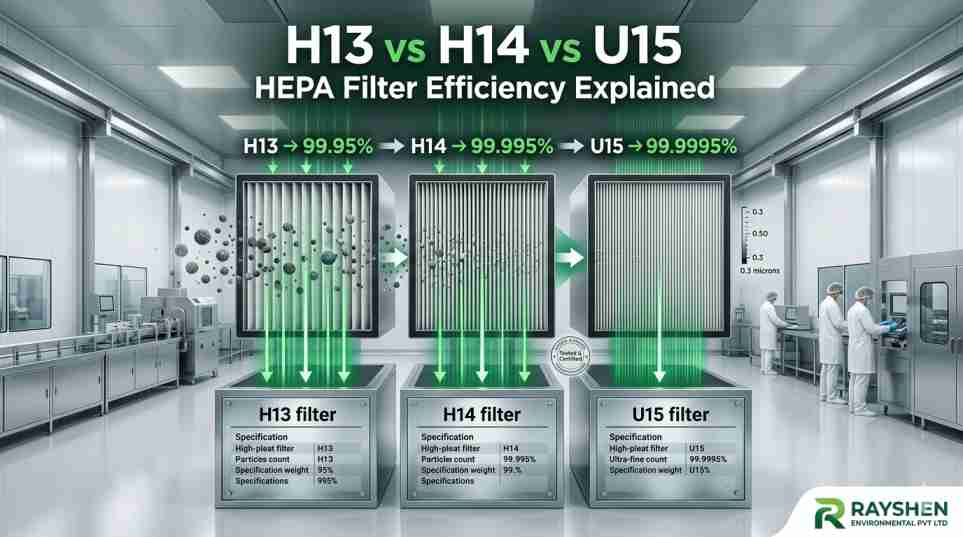
In the hierarchy of the EN 1822 standard, the jump from H13 to H14 is the most significant transition in cleanroom engineering.
The H13 HEPA Filter
Efficiency: 99.95% at MPPS.
Permissible Penetration: 0.05%.
Application: H13 filters are the workhorse of high-end commercial HVAC and "lower-tier" cleanrooms (ISO Class 7 or 8). They are excellent for general hospital areas, food processing, and high-tech assembly where "sterile" isn't required, but "very clean" is.
The H14 HEPA Filter
Efficiency: 99.995% at MPPS.
Permissible Penetration: 0.005%.
The Critical Difference: While the percentage difference (0.045%) looks small on paper, an H14 filter is actually ten times more effective at stopping contaminants than an H13.
Application: This is the mandatory Pharmaceutical Grade Air Filter for Grade A and Grade B cleanrooms. If your process involves open vials, surgical implants, or semiconductor etching, H14 is your baseline.
3. U15 ULPA Filters: When HEPA Isn't Enough
Beyond the HEPA category lies the ULPA (Ultra-Low Penetration Air) category. A U15 filter offers an efficiency of 99.9995%.
While it provides the ultimate protection, it comes with a "pressure penalty." The media is much denser, requiring a more powerful HEPA filter for HVAC system fans to push air through. In 2026, U15 filters are primarily reserved for nanotech laboratories and state-of-the-art silicon wafer fabrication where a single 0.1-micron particle can ruin a multi-thousand-dollar chip.
4. Structural Engineering: Mini Pleat vs. Deep Pleat
As a leading Cleanroom Air Filter Manufacturer, Rayshen emphasizes that how the glass fiber is folded determines the unit's lifespan and energy consumption.
The Mini Pleat HEPA Filter
This is the modern standard for ceiling-mounted Fan Filter Units (FFUs).
Design: These use very thin thermoplastic "glue" beads to separate the pleats. This allows for a massive amount of filter media to be packed into a very shallow frame (typically 50mm to 100mm deep).
Advantages: Because there is more surface area, the air velocity through the media is lower, which significantly reduces the Initial Pressure Drop. This means lower electricity bills and quieter operation.
Deep Pleat HEPA Filter India
The Deep Pleat HEPA Filter is a robust alternative often used in the primary Air Handling Units (AHUs) of large industrial complexes.
Design: These use corrugated aluminum separators to keep the folds apart, with depths often reaching 292mm (12 inches).
Advantages: They are built to handle extremely high volumes of air (up to 2000-3000 CMH). In the Indian industrial climate, where dust loads can be high, the deep pleat design offers the structural rigidity needed for heavy-duty HVAC systems.
5. Integrating the HEPA Filter for HVAC System Success
A high-quality filter is useless if the air can bypass it. This is why the integration into the HEPA filter for HVAC system housing is a critical check-point.
Gel Seal vs. Gasket Seal
Gasket Seals: Use a neoprene or EPDM foam to create a physical compression seal. While effective, they can lose elasticity over time.
Gel Seals: The filter frame is "dipped" into a channel filled with specialized silicone gel. This creates a 100% airtight, leak-proof barrier. For H14 pharmaceutical applications, gel seals are the industry recommendation to ensure you pass the mandatory PAO/DOP scan tests.
6. The Economic Reality: Total Cost of Ownership (TCO)
When sourcing from a Cleanroom Air Filter Manufacturer, the "sticker price" is only 20% of the total cost. The remaining 80% is energy consumption and replacement labor.
The Cost of Pressure Drop
Every Pascal (Pa) of resistance in your filter forces your fan motors to draw more current. By choosing a Mini Pleat HEPA Filter with a lower initial resistance, a facility can save thousands of dollars per year in utility costs. In 2026, "Green Cleanrooms" are focusing on H14 filters that offer high efficiency with a low-pressure footprint.
7. Quality Assurance: The Rayshen Standard
As a premier provider of Deep Pleat HEPA Filter India solutions and global pharmaceutical filters, Rayshen subjects every unit to the "Leak Scan Test."
Why Scan Testing Matters
A single pinhole leak in the media or a hairline crack in the frame seal will cause a cleanroom to fail its ISO certification. We use Dispersed Oil Particulate (DOP) testing to "smoke" the filter and ensure that the efficiency is uniform across the entire surface area. This level of EEAT (Expertise, Authoritativeness, and Trustworthiness) is what separates a generic air filter from a Pharmaceutical Grade Air Filter.
8. Maintenance and Lifecycle Management
To maximize the life of your HEPA filter H14, a multi-stage filtration strategy is essential:
Pre-Filters (G4): To catch hair, lint, and large dust.
Fine Filters (F7/F9): To catch the bulk of atmospheric soot and pollen.
HEPA Filter (H14): The final barrier.
By protecting the HEPA filter with high-quality pre-filtration, you can extend the replacement cycle from 12 months to 3–5 years, significantly improving your ROI.
Conclusion: Engineering Your Cleanroom for 2026
The choice between H13 vs H14 HEPA filters is a choice between "clean" and "compliant." For the pharmaceutical, biotech, and high-tech industries, the HEPA Filter H14 is the only logical choice to ensure safety and audit success.
Whether you require the high-capacity Deep Pleat HEPA Filter India standard or the energy-efficient Mini Pleat HEPA Filter for your ceiling grids, Rayshen stands as your expert partner in air integrity.
Don't leave your air quality to chance. Protect your product, your personnel, and your profits with world-class filtration.
[Request a Technical Consultation with Rayshen Engineers] [Get a Bulk Quote for H14 Pharmaceutical Grade Air Filters]
Frequently Asked Questions (FAQs)
1. What is the difference between an H13 and H14 HEPA filter?
The primary difference lies in the filtration efficiency at the Most Penetrating Particle Size (MPPS). An H13 HEPA filter has an efficiency of 99.95%, while a HEPA filter H14 is 99.995% efficient. In practical terms, an H14 filter is ten times more effective at stopping microscopic contaminants, making it the standard for sterile pharmaceutical environments.
2. When should I use a Mini Pleat HEPA filter vs. a Deep Pleat design?
A Mini Pleat HEPA filter is ideal for space-constrained areas like Fan Filter Units (FFUs) and cleanroom ceilings because it offers high surface area with a slim profile. A Deep Pleat HEPA filter is better suited for high-volume Air Handling Units (AHUs) in industrial HVAC systems, as its rugged design with aluminum separators can handle significantly higher airflows (CMH).
3. Is an H14 HEPA filter considered "Pharmaceutical Grade"?
Yes. In the pharmaceutical industry, particularly for Grade A and B zones, the HEPA filter H14 is the mandatory minimum. It ensures that the air entering aseptic filling lines or sterile suites meets the rigorous particle count requirements of WHO-GMP and ISO 5 standards.
4. How does a HEPA filter for HVAC systems impact energy costs?
The "Initial Pressure Drop" of a HEPA filter for HVAC system use determines how hard your fans must work. High-quality Mini Pleat HEPA filters from a reputable Cleanroom Air Filter Manufacturer like Rayshen are designed with lower resistance, which can reduce annual energy consumption by up to 15-20% compared to low-grade alternatives.
5. What are the benefits of sourcing from a Deep Pleat HEPA filter India manufacturer?
Sourcing locally from a specialist like Rayshen ensures faster lead times, customized sizing for Indian HVAC standards, and compliance with local regulatory audits. Additionally, it reduces the risk of filter media damage that often occurs during long-distance international shipping.
6. How often do H14 HEPA filters need to be replaced in a cleanroom?
While the lifespan depends on the dust load, a properly protected Pharmaceutical Grade Air Filter typically lasts 3 to 5 years. This longevity is achieved by using high-quality G4 and F9 pre-filters to capture larger particles, leaving the HEPA filter to handle only the sub-micron contaminants.
.png)
.png)