Slashing HVAC OpEx: The Impact of Low-Resistance HEPA Filters on Cleanroom Energy Consumption
03-04-2026
In 2026, the global pharmaceutical and semiconductor industries are facing a dual mandate: achieving absolute sterile compliance while meeting aggressive Net-Zero sustainability targets. For any high-tech manufacturing facility, the HVAC system is the single largest consumer of electricity—often accounting for 60% to 70% of total site energy.
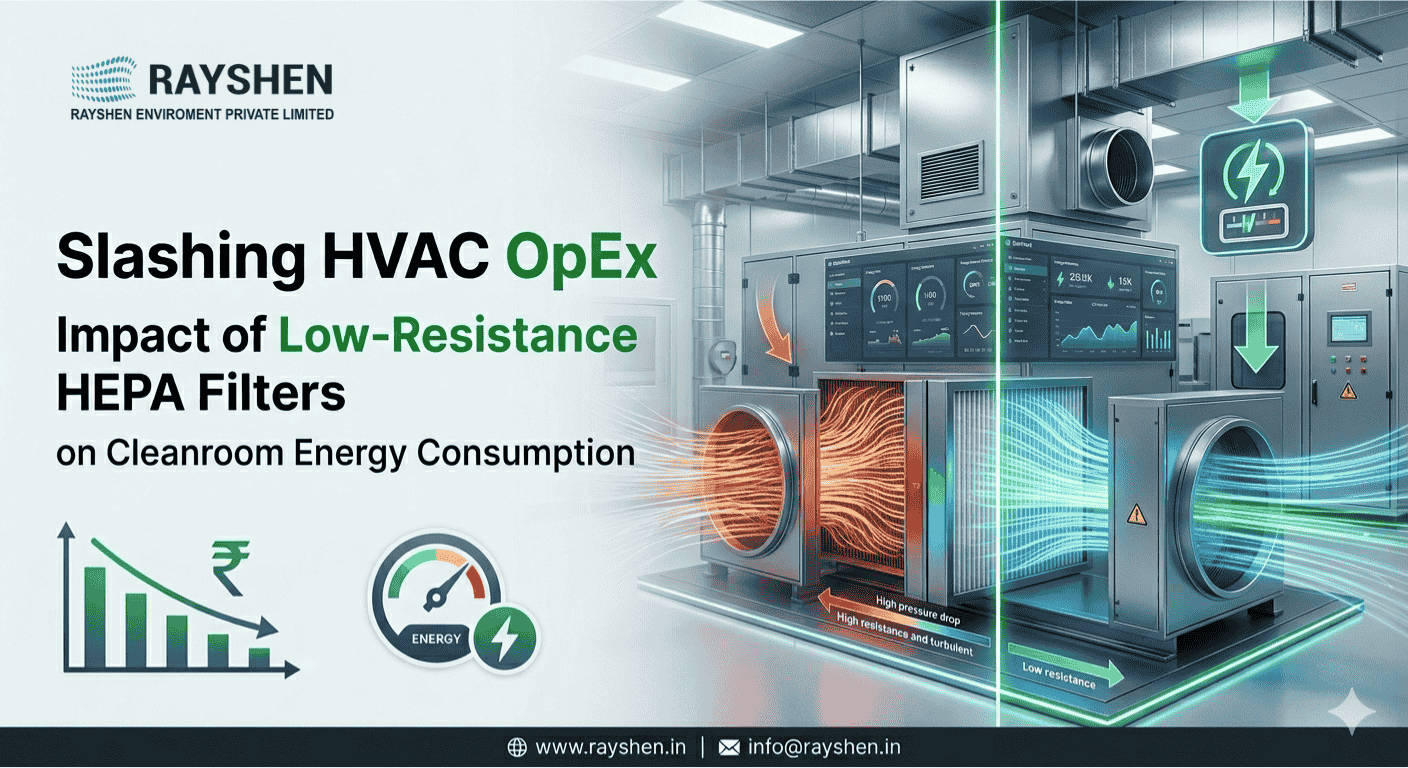
At the heart of this energy consumption lies a mechanical conflict: the need for ultra-pure air versus the massive "Pressure Drop" created by high-efficiency filters. As a leading HEPA filter manufacturer, Rayshen has pioneered Low-Resistance (Low-DP) technology that allows facilities to maintain ISO 14644 standards while slashing operational expenditure (OpEx) by up to 30%.
1. The Physics of Resistance: Why HEPA Filters Drain Your Budget
To understand how to save money, one must understand the "Energy Penalty" of air filtration. A HEPA filter is essentially a dense maze of borosilicate glass fibers. As air is forced through this maze, it encounters resistance, known as Pressure Drop (ΔP).
The Exponential Cost of Fan Power
The relationship between filter resistance and energy is not linear; it is exponential. According to the Fan Laws, if the resistance of your filter bank increases, the fan motor must work significantly harder to maintain the required Air Changes Per Hour (ACH).
The Reality: A HEPA filter with an initial pressure drop of 250 Pa costs significantly more to operate over three years than a Rayshen Low-Resistance Filter starting at 180 Pa.
2. 2026 Regulatory Context: ISO 14644-16 and Energy Performance
The recent widespread adoption of ISO 14644-16 (Energy Efficiency in Cleanrooms) has changed the way facility managers approach procurement. It is no longer enough to just "clean the air"; you must do so with the lowest possible carbon footprint.
Beyond Efficiency: The "Total Cost of Ownership" (TCO)
In 2026, savvy HVAC consultants have moved away from "Initial Purchase Price" and toward TCO Models.
The "Cheap" Filter Trap: A low-cost filter often uses lower-quality media with a higher pressure drop. Within 12 months, the extra electricity consumed by the AHU (Air Handling Unit) to push air through that "cheap" filter will exceed the cost of the filter itself by 3x.
The Rayshen Approach: Our mini-pleat H14 filters are engineered for high dust-holding capacity (DHC), meaning the pressure drop stays lower for longer, extending replacement cycles and saving energy.
3. Mini-Pleat Technology: The Secret to Low-Resistance
How does Rayshen achieve a lower pressure drop without compromising the 99.995% efficiency required for ISO Class 5 environments? The answer lies in Mini-Pleat Geometry.
Maximizing Surface Area, Minimizing Turbulence
Traditional deep-pleat filters use aluminum separators that can cause air turbulence. Rayshen’s Mini-Pleat HEPA filters use thermoplastic hot-melt separators.
Higher Media Density: We pack more square meters of filter media into the same frame size.
Laminar Airflow: The precise spacing of pleats ensures that air moves in a unidirectional, laminar fashion, reducing friction and energy loss.
4. Impact on Semiconductor Fabs: ULPA vs. HEPA
In India’s rapidly growing semiconductor sector, even a 0.1-micron particle is a "killer defect." Here, the energy challenge is even greater because these labs require ULPA (U15-U17) filters.
Nanofiber Innovation for Sub-Micron Purity
Rayshen’s latest U16 ULPA filters utilize nanofiber coatings. These fibers are so thin that they capture particles through "interception" and "diffusion" more effectively while allowing air molecules to pass through with 20% less resistance than standard glass fiber. For a 24/7 semiconductor fab, this equates to millions of rupees saved in annual utility bills.
5. Maintenance Strategies: Finding the "Golden Cross"
To slash OpEx, you must know when to change your filters. Changing them too early wastes material; changing them too late wastes electricity.
Predictive Monitoring and Differential Pressure
Using Smart Cleanroom Sensors, facility managers can now track the "Golden Cross"—the exact point where the cost of the energy penalty exceeds the cost of a new filter.
Rayshen’s Advice: Never let your terminal HEPA filters reach more than 2x their initial pressure drop. By replacing them at the optimized time, you maintain peak HVAC efficiency and prevent motor burnout in your AHUs.
6. The Environmental, Social, and Governance (ESG) Angle
For large Pharma corporations, reducing cleanroom energy is a key part of their ESG Reporting.
Scope 2 Emission Reduction: Lowering fan power directly reduces your facility's carbon footprint.
Waste Reduction: High-DHC filters from Rayshen last 30% longer, meaning fewer filters end up in landfills, aligning with "Circular Economy" goals.
7. Frequently Asked Questions (FAQs)
Q1: Can I use Low-Resistance filters in my existing HVAC system?
Yes. Rayshen’s energy-efficient HEPA filters are designed to be "Drop-In" replacements for standard sizes (e.g., 610x610x69mm or 305x610x292mm). No ductwork modification is required.
Q2: Does a lower pressure drop mean lower filtration efficiency?
Absolutely not. Efficiency is determined by the quality of the borosilicate glass fiber. Resistance is determined by the pleat design and surface area. Rayshen maintains a guaranteed 99.995% efficiency while reducing resistance.
Q3: What is the typical ROI for switching to Low-Resistance HEPA?
Most industrial facilities see a Return on Investment (ROI) within 14–18 months purely from electricity savings, not counting the reduced wear and tear on HVAC motors.
Conclusion: The Rayshen Advantage in Energy-Smart Filtration
In the competitive landscape of 2026, Cleanroom Equipment must be judged by its impact on the bottom line. High-quality, low-resistance filtration is no longer an "option"—it is a mechanical necessity for any facility looking to stay profitable and compliant.
By partnering with Rayshen, you aren't just buying a filter; you are investing in a sophisticated energy-saving tool that protects your product, your personnel, and your profit margins.
Stop overpaying for your cleanroom energy.
Contact Rayshen Today for a Customized HVAC Energy Audit and HEPA Quote
.png)
.png)