HEPA Filter Cleanroom Guide: H13 vs H14 Filtration | Rayshen
08-06-2026
The Ultimate Guide to HEPA Filter Technology: Maximizing Cleanroom Compliance and Contamination Control
In modern industrial processing, invisible airborne contaminants present an ongoing risk to production yields, financial profitability, and regulatory compliance. A single microscopic dust particle, viable bacterial spore, or aerosol droplet can compromise an entire production batch of sterile pharmaceuticals, damage a semiconductor wafer layout, or cause post-operative infections in a hospital surgical unit. For facilities operating under precise environmental classifications, high-efficiency air quality management is not merely a preference—it is a critical engineering requirement.
At the baseline of any effective environmental control framework sits the HEPA Filter (High-Efficiency Particulate Air Filter). Far more than a standard commercial HVAC air filter, industrial-grade HEPA technology serves as the primary barrier against sub-micron particulate contamination. For pharmaceutical production managers, cleanroom contractors, and HVAC consultants across the globe, selecting the appropriate filtration architecture represents a fundamental design step that directly impacts contamination control, operational pressure drop, and energy efficiency.
As a premier cleanroom air filter manufacturer, Rayshen Environmental Pvt Ltd engineers advanced clean air solutions designed to meet strict international standards, including ISO 14644 and global GMP compliance frameworks. This comprehensive technical guide breaks down the science, mechanical performance, and configuration options of high-efficiency filtration systems, helping your facility maintain sterile manufacturing operations and pass stringent regulatory audits.
What Is a HEPA Filter?
The term HEPA stands for High-Efficiency Particulate Air. By definition under international standards (such as EN 1822 and ISO 29463), a certified HEPA filter must capture at least 99.97% of airborne particles down to a size of 0.3 micrometers. This specific measurement represents the Most Penetrating Particle Size (MPPS), which is the most challenging physical diameter for an air filtration system to retain. Particles that are either larger or smaller than 0.3 micrometers are actually captured with even higher efficiency due to the multi-layered mechanics of the filter media.
Unlike basic commercial filters that rely on coarse synthetic strands to catch large fibers, an industrial HEPA filter is constructed from a dense, interwoven matrix of randomly oriented borosilicate glass microfibers. These microfibers generally measure between 0.5 and 2.0 micrometers in diameter. This matrix creates a labyrinth-like path for the air streams, forcing microscopic airborne particles to encounter multiple physical capture barriers while allowing cleaned air to move smoothly through the system. This design forms the foundation of modern cleanroom filtration and structural isolation zones.
How Does a HEPA Filter Work?
A frequent misconception among facility operators is that a HEPA filter operates like a standard mechanical screen or sieve, where particles larger than the open gaps are blocked while smaller ones pass through. If filtration relied solely on straining, sub-micron particulates would easily pass through the filter media. Instead, high-efficiency particle filtration relies on a combination of distinct microfluidic physics mechanisms to capture and hold contaminants as air moves through the system.
Interception
Interception occurs when an airborne particle follows the established streamline of the airflow but passes close enough to a glass microfiber to come into direct contact with its edge. If the distance between the air streamline and the fiber surface is equal to or less than the physical radius of the particle, the contaminant attaches to the fiber matrix. This capture mechanism primarily handles mid-sized particulate matter, typically ranging between 0.1 and 1.0 micrometers in diameter.
Impaction
Impaction, or inertial impact, targets larger, high-mass particles that travel within the airstream. Because these particles possess significant inertia, they cannot adapt to the abrupt shifts in air direction as the stream weaves around the glass microfibers. Instead of following the curving streamline, they continue along a straight trajectory, colliding directly with the fiber face and embedding permanently into the collection matrix. Impaction is highly effective at managing heavy dust and particulate matter moving at standard system velocities, typically above 1.0 micrometer.
Diffusion
Diffusion targets the smallest, lowest-mass particles moving through the air filtration system (generally under 0.1 micrometers). These ultra-fine particles do not follow steady air streamlines; instead, they are continuously bumped by surrounding gas molecules in the air stream. This molecular collision causes them to move in an irregular, zig-zag pattern known as Brownian Motion. This wandering path significantly increases the time the particle spends within the media matrix, maximizing the probability that it will collide with a glass fiber and stick via molecular attraction. Because diffusion is highly effective at lower face velocities, it ensures the reliable capture of ultrafine viral paths and nanometer-scale pollutants.
HEPA Filter Efficiency Explained
When engineering air delivery loops for high-purity zones, matching the specific filter efficiency classification to your required cleanroom class is essential. Under the widely accepted European standard EN 1822, filters are evaluated at their exact Most Penetrating Particle Size (MPPS) and categorized into clear capability tiers. The highest tiers—H13 and H14—form the backbone of critical industrial filtration installations.
Understanding H13 HEPA Filter
An H13 HEPA filter represents the entry point for ultra-low penetration industrial environments. It delivers an overall efficiency rating of 99.95% at the MPPS. This means that out of every 100,000 sub-micron particles passing through the media, a maximum of 50 particles can escape downstream. This level of control is highly effective for primary air handling units, general pharmaceutical cleanroom zones, and clinical areas that require reliable airborne particle removal without creating excessive initial system static pressure.
Understanding HEPA Filter H14
The HEPA filter H14 represents a significant upgrade in capture performance, delivering a minimum efficiency rating of 99.995% at the MPPS. At this tier, penetration is limited to a maximum of just 5 particles out of every 100,000. This configuration reduces overall particle penetration by a factor of ten compared to an H13 module. This extreme level of process isolation is essential for terminal supply grids, aseptic filling lines, and environments where any level of product contamination can lead to significant material losses or regulatory violations.
H13 vs H14 HEPA Filter Comparison
The choice in the H13 vs H14 HEPA filter evaluation depends directly on the cleanroom class required by your process. While an H13 module is excellent for secondary buffer rooms, general hospital corridors, and ISO Class 7 or Class 8 environments, critical production zones demand the higher precision of an H14 layout.
Consider the following technical comparison:
H13 Filter: 99.95% efficiency, maximum local penetration of 0.25%, lower initial pressure drop, typical for ISO Class 7/8 applications.
H14 Filter: 99.995% efficiency, maximum local penetration of 0.005%, higher precision media density, mandatory for ISO Class 5 (Grade A) aseptic zones.
By integrating the higher-rated HEPA filter H14 into terminal supply points, facilities can maintain a reliable barrier against sub-micron contamination.
Mini Pleat HEPA Filter vs Deep Pleat HEPA Filter
To pack a large surface area of borosilicate media into a rigid frame, the material must be folded into tight pleats. The structural design of these pleat folds divides high-efficiency filters into two main configurations: Mini Pleat and Deep Pleat models.
Benefits of Mini Pleat HEPA Filters
A mini pleat HEPA filter utilizes shallow fold depths, typically ranging between 25 and 50 mm, packed tightly together. Instead of using thick, traditional separators to keep the folds apart, mini pleat designs employ thin ribbons of hot-melt adhesive or specialized textile threads to maintain uniform spacing.
This low-profile architecture offers several operational benefits:
Lightweight and Compact: The slim profile makes mini pleat units ideal for terminal ceiling modules, compact Fan Filter Units (FFU), and cleanroom equipment where vertical space is limited.
Uniform Laminar Airflow: The tightly controlled, closely spaced pleat pattern ensures a highly even distribution of air velocity across the entire face of the filter, minimizing downstream turbulence.
Energy Efficiency: By optimizing the ratio of active media surface area to overall casing volume, mini pleats can help reduce operating pressure drop in modern air delivery systems.
Benefits of Deep Pleat HEPA Filter India
A deep pleat HEPA filter India standard configuration utilizes deep, V-shaped folds of filter media that run anywhere from 150 mm to 300 mm deep. To keep these large, deep pleats from collapsing against one another under high airflow volumes, corrugated aluminum ribbons or treated kraft paper separators are placed between the folds.
Key benefits of deep pleat configurations include:
High Dust Holding Capacity: The deep fold structure allows for a larger total volume of media material, enabling the filter to accumulate significant particulate weight before reaching its terminal pressure drop.
Heavy Volumetric Airflow Handling: These filters are designed to manage high air volumes within centralized Air Handling Units (AHUs), making them highly resilient against fluctuating system pressures.
Robust Structural Design: The inclusion of corrugated metal separators provides excellent resistance against mechanical deformation in demanding, high-velocity air ducts.
Which Option Is Right for Your Facility?
The choice between these two designs depends on your facility's physical layout and air distribution strategy:
Select the Mini Pleat design when you are installing terminal filters directly into cleanroom ceilings, using localized Fan Filter Units (FFU), or engineering laminar airflow benches that require uniform air velocities and space-saving dimensions.
Select the Deep Pleat design when you are sourcing filters for large, centralized Air Handling Units (AHUs), retrofitting older HVAC air filter housings, or managing environments with high ambient particulate levels where maximizing filter service life is a key financial priority.
Applications of HEPA Filters
High-efficiency air filtration systems are a standard requirement across a variety of modern industries, each operating under specific quality, safety, and environmental frameworks.
Pharmaceutical Manufacturing: In this sector, air quality is tied directly to patient safety and product efficacy. Facilities rely on pharmaceutical grade air filters to maintain strict sterile manufacturing environments. These systems eliminate airborne micro-organisms during the formulation, filling, and packaging of liquid injectables and solid oral dosages, helping companies meet strict GMP compliance requirements.
Cleanrooms: Industrial cleanrooms spanning ISO Class 1 through ISO Class 9 rely on continuous air changes to scrub the environment of particulates. High-efficiency filters provide the primary validation boundary, ensuring that the ambient air within the workspace remains well within certified limits.
Hospitals & Operation Theatres: Managing healthcare-associated infections (HAIs) is a primary focus for clinical engineers. Hospital air filtration setups use terminal H14 filtration grids to supply sterile, pathogen-free air directly over the surgical field. This rapid dilution and airborne particle removal help protect open incisions from opportunistic environmental pathogens.
Biotechnology Facilities: Research centers manipulating live viral vectors, cell cultures, or genetic sequences use high-efficiency filtration to protect both the sensitive internal processes from cross-contamination and the outside environment from potential biological leaks.
Semiconductor Manufacturing: As modern microchips scale down to nanometer dimensions, microscopic airborne dust can land on circuit pathways, causing shorts and destroying production yields. Semiconductor cleanrooms rely on expansive, high-density mini-pleat filter ceilings to maintain near-zero particulate environments.
Research Laboratories: High-containment laboratories (BSL-3 and BSL-4) handle highly sensitive or hazardous compounds. These facilities install specialized heavy-duty filtration setups to ensure that exhaust air streams are thoroughly scrubbed before being safely released into the atmosphere.
Food Processing Facilities: To extend product shelf-life and prevent spoilage without relying on chemical preservatives, food packaging lines use clean air systems to eliminate mold spores, yeast strains, and airborne bacteria during the filling and sealing phases.
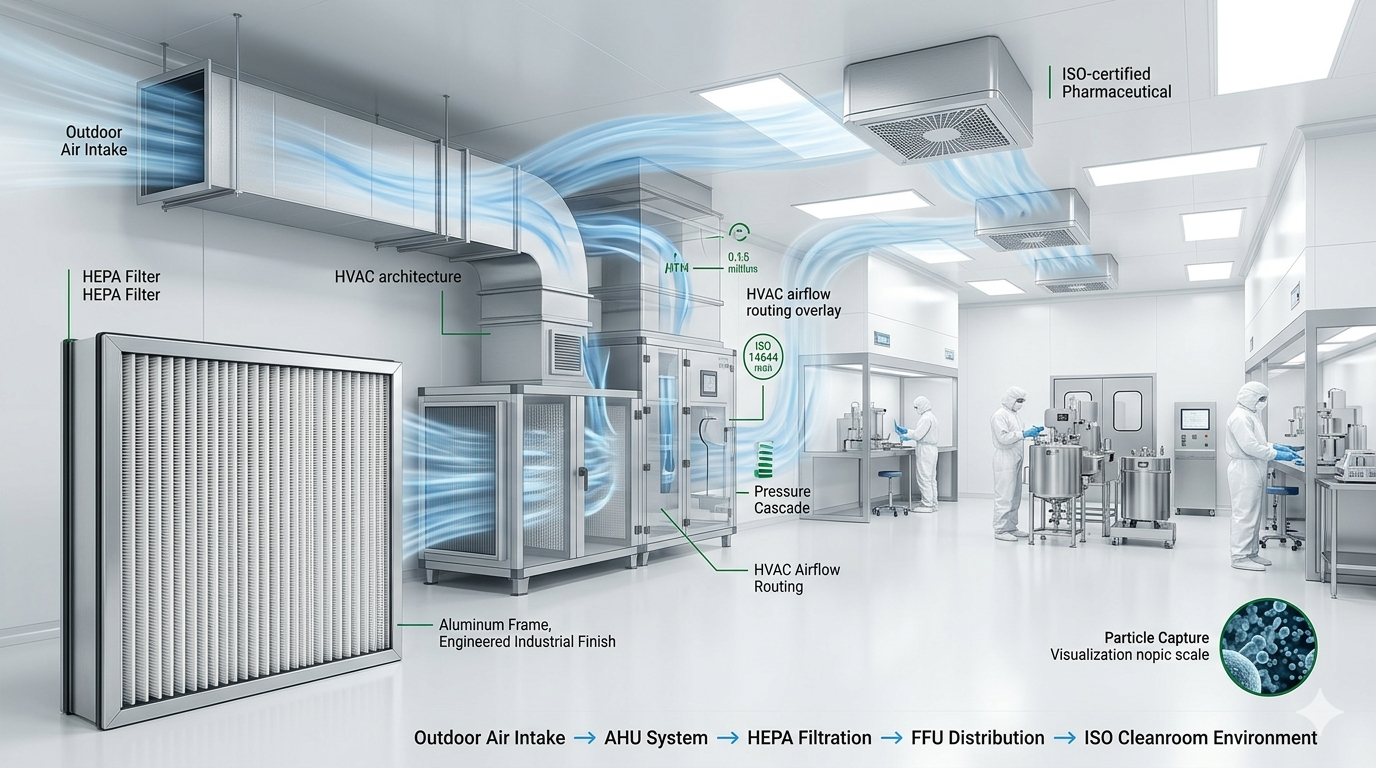
Why HEPA Filters Are Critical for HVAC Systems
Integrating a high-efficiency filter directly into a facility's centralized climate network requires careful engineering. A HEPA filter for HVAC system installations provides comprehensive protection across the entire facility, but it must be balanced against the system's aerodynamic capacity.
[Return Air] ---> [G4 Pre-Filter] ---> [F9 Intermediate Filter] ---> [Supply Fan] ---> [Terminal HEPA Filter (H14)] ---> [Cleanroom Space]
Pressure Drop Considerations: High-efficiency filter media is naturally dense, creating a higher initial resistance (pressure drop) compared to standard pleated panels. If an HVAC system is not designed with sufficient static fan pressure, adding a high-efficiency filter can restrict airflow, reduce total air changes per hour (ACPH), and place excessive strain on the fan motor.
Airflow Performance: Maintaining proper airflow requires careful monitoring of the filter's resistance profile. Air handling units must be calibrated to deliver stable face velocities (typically around 0.45 m/s for laminar cleanrooms) even as the filter media loads with particulates over time.
Energy Efficiency: By utilizing advanced mini-pleat configurations that maximize active surface area, facilities can lower resistance profiles. This allows air handling systems to maintain required air changes while minimizing fan energy consumption.
Why Pharmaceutical Grade Air Filters Matter
In a pharmaceutical manufacturing facility, air filtration is a critical factor in regulatory compliance. Regulatory bodies such as the USFDA, EMA, and CDSCO require rigorous contamination control verification to prevent batch contamination and ensure product safety.
GMP Requirements: Good Manufacturing Practices mandate that Grade A aseptic processing zones maintain zero viable colonies and extremely low particle counts during operational periods. Sourcing a verified pharmaceutical grade air filter ensures that terminal supply points possess the microfluidic properties needed to meet these strict requirements.
Sterile Manufacturing Assurance: Passing regulatory audits requires comprehensive documentation. High-quality cleanroom filters provide verifiable, consistent performance, protecting critical processes like sterile vial filling from non-viable particulate matter and bacterial carriers.
Benefits of Choosing a Custom Size HEPA Filter
While standard sizes (like 610 mm x 610 mm) are common in standard commercial properties, industrial cleanrooms often feature specialized machinery, custom ceiling grids, or proprietary containment housings that standard options cannot accommodate.
Space Optimization: Sourcing a custom size HEPA filter allows engineering teams to maximize the available footprint inside terminal hoods, pass boxes, or air showers without being constrained by standard factory dimensions.
Improved Efficiency: A custom-engineered filter fits precisely into its housing frame. This exact fit ensures an airtight physical seal, eliminating the risk of air bypass leaks that can compromise cleanroom integrity.
Better Airflow Control: Custom configurations allow facilities to tailor the pleat count, depth, and face area to their specific fan capacities, ensuring optimal face velocity and proper air distribution across the workspace.
How to Select the Right Cleanroom Air Filter Manufacturer
Partnering with a qualified cleanroom air filter manufacturer is essential for ensuring long-term facility compliance and operational reliability. B2B buyers should evaluate several key technical and manufacturing criteria:
Certifications and Compliance: Verify that the manufacturer operates under an ISO 9001 quality management framework and tests all high-efficiency products in strict accordance with international standards EN 1822 and ISO 29463.
Testing Standards: Reliable manufacturers conduct individual leak testing on every single HEPA unit before it leaves the facility. This is typically done using PAO (Polyalphaolefin) or DOP aerosol challenges to scan the media surface and frame seals for any localized leaks. Each filter should ship with its own unique test report detailing its rated efficiency and initial pressure drop.
Manufacturing Capability: Look for manufacturers with modern, automated pleating systems housed within controlled environments. This prevents the media from being exposed to dust or suffering physical damage during production.
Technical Support and Quality Assurance: Sourcing filtration equipment involves detailed technical alignment. A dependable supplier provides comprehensive engineering support, assisting with static pressure calculations, material selections, and onsite validation testing.
Why Choose Rayshen Environmental Pvt Ltd
Rayshen Environmental Pvt Ltd is a trusted provider of high-performance air filtration and cleanroom equipment, delivering engineered solutions that meet the demanding requirements of critical manufacturing industries across India and global markets.
Advanced Manufacturing Infrastructure: Our production facility utilizes automated pleating technology and high-precision tooling to manufacture mini pleat and deep pleat filters with exceptional structural integrity and low initial resistance.
Certified H13 & H14 HEPA Filters: We manufacture a complete range of certified high-efficiency filters. Each H13 and H14 module is individually tested and validated to ensure reliable airborne particle removal and full compliance with international standards.
Mini Pleat and Deep Pleat Solutions: From low-profile mini pleat filters for Fan Filter Units (FFU) to robust deep pleat models for heavy-duty industrial filtration, we offer a versatile product portfolio tailored to your specific system demands.
Custom Size HEPA Filters: We provide comprehensive customization capabilities, manufacturing filters to exact client dimensions, casing depths, and material preferences (including Anodized Aluminum, 304/316 Stainless Steel, and Galvanized Iron).
100% Factory Validation Testing: Every filter produced by Rayshen undergoes individual PAO leak testing and resistance verification. Each unit is accompanied by a dedicated validation certificate, providing the documentation needed for regulatory audits.
Technical Expertise and Service Support: Our engineering team offers end-to-end technical guidance, from initial design consultation and system sizing to long-term maintenance support and nationwide product delivery.
Maintenance and Replacement Best Practices
To maximize the service life of your high-efficiency filters and prevent unexpected operational downtime, facility maintenance teams should implement a structured preventive maintenance protocol.
Monitor Differential Pressure: Install calibrated differential pressure gauges (such as Magnehelic gauges) across every filter bank. Track these readings regularly. A filter should typically be replaced when it reaches its designated terminal pressure drop—which is usually twice the initial clean pressure drop, or as specified by the system designer.
Utilize Multi-Stage Pre-Filtration: Never expose an expensive high-efficiency filter to raw, unfiltered outdoor air. Implement a multi-stage approach using coarse pre-filters (G4 class) and intermediate secondary filters (F9 class) upstream in the Air Handling Unit. This cost-effective configuration traps larger dust particles early, extending the life of your terminal filters.
Conduct Regular Integrity Testing: Schedule in-situ PAO aerosol leak testing every 6 to 12 months. This routine verification checks for any media damage or gasket bypass leaks, ensuring the system continues to maintain its required cleanroom classification.
Future Trends in HEPA Filtration Technology
Driven by global sustainability initiatives and evolving regulatory frameworks, the air filtration industry continues to innovate. A major current trend is the development of low-resistance glass fiber and membrane media formulations that maintain an H14 efficiency rating while reducing operating pressure drop, helping facilities lower their overall fan energy consumption.
Additionally, the integration of smart differential pressure sensors tied directly to centralized Building Management Systems (BMS) is becoming more common. This allows maintenance teams to continuously monitor filter performance, moving from rigid, calendar-based replacement schedules to predictive, data-driven maintenance that reduces operational waste while ensuring environmental control.
Frequently Asked Questions (FAQs)
1. What is the difference between an H13 and an H14 HEPA filter?
An H13 filter provides a minimum efficiency of 99.95% at the Most Penetrating Particle Size (MPPS), allowing up to 50 particles out of 100,000 to pass through. An H14 filter delivers a higher efficiency of 99.995%, restricting penetration to just 5 particles out of 100,000. This makes the H14 ten times more effective at capturing sub-micron contaminants in critical zones.
2. How often should a mini pleat HEPA filter be replaced?
When supported by a well-maintained multi-stage pre-filtration system (such as G4 and F9 stage panels), a terminal mini pleat filter typically lasts between 3 to 5 years. The exact replacement timing should always be determined by monitoring pressure drop changes or through routine onsite leak testing.
3. Can a HEPA filter for HVAC system installations be washed and reused?
No. Industrial high-efficiency filters are constructed from delicate, densely layered borosilicate glass microfibers. Attempting to wash them with water or clean them with compressed air will disrupt the fiber matrix, tear the media, and permanently ruin its filtration efficiency. These filters must be replaced once they reach their terminal pressure drop.
4. Why is a deep pleat HEPA filter India standard used in large Air Handling Units?
Deep pleat designs feature deep folds with aluminum separators that provide substantial mechanical strength and a high dirt-holding capacity. This makes them well-suited for the high-volume, variable airflows found in centralized Air Handling Units (AHUs), particularly in regions with high ambient dust levels.
5. What is the role of a pre-filter in a cleanroom filtration system?
Pre-filters (such as G4 panels) trap large dust particles, lint, and coarse debris before they can reach the primary high-efficiency filters. Because pre-filters are inexpensive and easy to replace, this multi-stage setup protects the more sensitive terminal filters from premature loading, significantly extending their operational lifespan.
6. How does Rayshen validate the performance of its custom size HEPA filters?
Every custom unit undergoes the exact same rigorous quality control testing as our standard models. This includes individual factory validation via PAO/DOP aerosol leak testing and differential pressure testing performed in accordance with EN 1822 standards. Each filter is shipped with its own specific validation certificate.
7. What frame material options does Rayshen offer for industrial filters?
We provide a variety of robust frame options to match your process requirements and chemical exposure needs, including Anodized Aluminum, 304 or 316 grade Stainless Steel, and Galvanized Iron (GI).
8. What are the standard testing intervals for cleanroom compliance verification?
According to ISO 14644-2 and standard GMP guidelines, high-efficiency filters installed in critical areas (such as Grade A aseptic zones) should undergo structural integrity and leak testing every 6 to 12 months to ensure continuous contamination control.
Secure Your Cleanroom Integrity with Rayshen
Maintaining reliable air quality is essential for regulatory compliance, product yield protection, and operational safety. At Rayshen Environmental Pvt Ltd, we manufacture high-performance air filtration products designed to meet the strict requirements of modern cleanrooms and industrial facilities. Whether you require certified H14 terminal modules, heavy-duty deep pleat configurations, space-saving mini pleat designs, or custom engineered sizes, our team delivers reliable, verified solutions.
Optimizing your facility's environmental control system begins with selecting the right filtration partner. Contact the engineering team at Rayshen Environmental Pvt Ltd today to review your project specifications, request a detailed technical quote, or discuss a customized air filtration solution for your facility.
Contact Our Filtration Engineers Now | Partner with Rayshen for Complete Peace of Mind
Explore Other Related Blogs
- HEPA Filter Efficiency Ratings Explained: H13 vs H14 vs U15 for Cleanrooms
- Optimizing Your AHU: How H14 Mini-Pleat Filters Reduce Pressure Drop and Slash Energy Bills
- ISO 14644 Compliance: Why H14 HEPA Filters are the Gold Standard for Indian Pharma Units
- The Ultimate Guide to HEPA Filters: Breathing Clean in a Post-2025 World
- H13 HEPA Filtration: The Unsung Hero of Modern Air Quality by Rayshen Environmental Private Limited
- H14: The Ultimate Guide to High-Efficiency HEPA Filtration in Modern Cleanrooms
- H13 HEPA Filters: The Backbone of Reliable Contamination Control in Modern Cleanrooms
.png)
.png)