What Does HEPA Stand For? Everything You Need to Know About HEPA Filtration
11-05-2026
In the landscape of modern industrial safety and environmental control, few acronyms carry as much weight as HEPA. Whether you are managing a high-tech semiconductor fab, a pharmaceutical laboratory, or a specialized hospital ward, the hepa standard is the invisible line of defense protecting your product and your personnel.
But what exactly lies behind these four letters? As a leading Cleanroom Air Filter Manufacturer, Rayshen provides this comprehensive deep dive into the history, physics, and technical applications of the hepa filter. By the end of this guide, you will understand how to choose between a Mini Pleat HEPA Filter and a Deep Pleat HEPA Filter India standard, ensuring your facility remains compliant and safe.
1. The Definition: What Does HEPA Stand For?
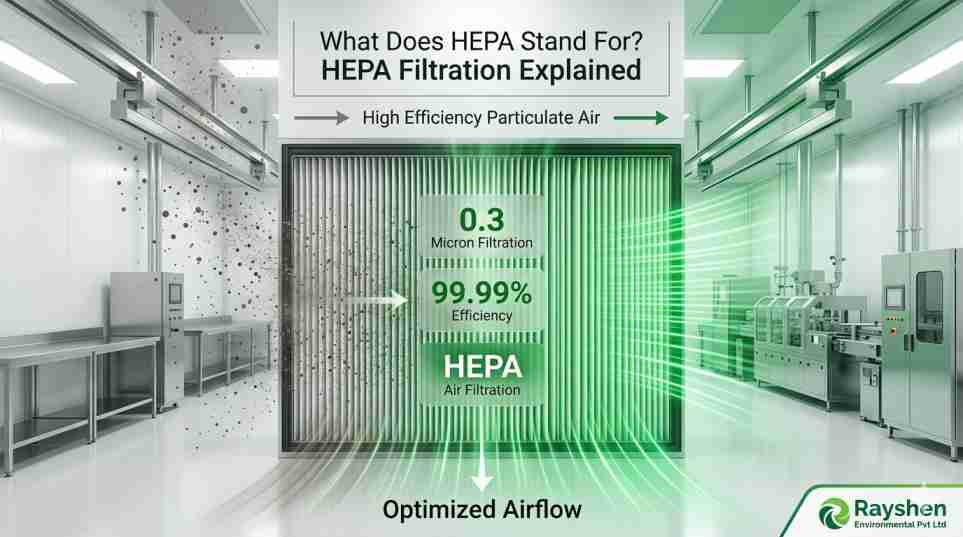
HEPA stands for High-Efficiency Particulate Air.
Unlike standard furnace filters or fiberglass pads found in residential units, a true hepa filter is designed to meet a specific, rigorous efficiency standard. To be classified as HEPA under global standards (such as EN 1822 or ISO 29463), a filter must be able to remove at least 99.97% of particles that are 0.3 microns in diameter.
Why 0.3 Microns?
It is a common misconception that 0.3 microns is the smallest particle a filter can catch. In reality, 0.3 microns is the Most Penetrating Particle Size (MPPS). Particles larger than this are easy to catch through "impaction," and particles smaller than this are actually easier to catch through "Brownian motion." The 0.3-micron measurement is the "weak point" of any filter; if a filter can catch 99.97% of those, it catches almost 100% of everything else.
2. Evolution of the Standard: From H13 to HEPA Filter H14
Not all HEPA filters are created equal. In the B2B world of cleanrooms, the distinction between grades is the difference between a successful batch and a contamination disaster.
H13 vs. H14 Efficiency
While a standard H13 filter is highly effective, the HEPA Filter H14 is the undisputed gold standard for sterile environments.
H13: 99.95% Efficiency.
H14: 99.995% Efficiency.
An H14 filter is effectively ten times more efficient than an H13 at the MPPS. For a Pharmaceutical Grade Air Filter, this marginal difference is critical. When you are dealing with sterile injectable drugs or microchip lithography, that 0.045% increase in efficiency represents a massive reduction in potential risk.
3. Anatomy of a High-Performance Filter
A hepa filter is not a simple sieve; it is a complex three-dimensional labyrinth of borosilicate glass fibers. These fibers are randomly arranged to maximize the surface area and the probability of a particle striking a fiber and sticking to it.
Mini Pleat HEPA Filter
In modern cleanroom design, the Mini Pleat HEPA Filter has become the industry favorite.
How it Works: These units use thermoplastic beads to separate the folds of the filter media.
Benefits: This design allows for a much higher density of filter paper within a slim frame. It provides a more uniform airflow and a significantly lower "initial pressure drop," which is vital for the efficiency of your HEPA Filter for HVAC System.
Deep Pleat HEPA Filter India
While mini-pleats are excellent for ceiling grids, the Deep Pleat HEPA Filter India standard remains a staple for high-volume industrial air handling units (AHUs).
How it Works: These filters use corrugated aluminum separators to keep the deep folds (often up to 12 inches deep) apart.
Benefits: They are incredibly rugged and can handle massive air volumes (up to 3000 CMH). They are the "heavy lifters" used in the primary filtration stages of large-scale manufacturing plants.
4. The Role of the Cleanroom Air Filter Manufacturer
Sourcing a hepa solution is about more than just buying a box; it is about engineering a system. A specialized Cleanroom Air Filter Manufacturer like Rayshen ensures that every unit is "scan-tested."
Quality Assurance and Testing
A filter can leave the factory with a 99.99% rating, but a single pinhole leak in the frame or a hairline crack in the media will render it useless for an ISO 5 environment. We utilize PAO (Polyalphaolefin) or DOP (Dispersed Oil Particulate) testing to verify the integrity of the filter face. This ensures that the air exiting the filter is truly sterile and free of bypass.
5. Customization: The Need for a Custom Size HEPA Filter
Cleanrooms are rarely "one size fits all." Older facilities or specialized laboratory equipment often require a Custom Size HEPA Filter that doesn't fit standard 2x4 or 2x2 grids.
Tailored Solutions for HVAC
At Rayshen, we recognize that HVAC consultants often face unique spatial constraints. Whether you need an ultra-slim profile for a specialized medical device or a non-standard dimension for an aging AHU, a Custom Size HEPA Filter ensures that you don't have to rebuild your entire ductwork to maintain compliance.
6. Integrating HEPA into Your HVAC System
A HEPA Filter for HVAC System use requires careful planning regarding static pressure. Because HEPA media is so dense, it creates significant resistance to airflow.
Managing Static Pressure
If your AHU fan is not powerful enough to overcome the resistance of an H14 filter, your airflow velocity will drop below the required 0.45 m/s, leading to stagnant air pockets. In 2026, the trend is toward "Low-Pressure" HEPA filters that provide high efficiency with lower energy consumption, helping facilities meet their ESG and sustainability goals.
7. Maintenance and Filter Longevity
The life of a hepa filter is measured in "pressure drop." As the filter traps more particles, it becomes harder for the air to pass through.
The Multi-Stage Strategy
To protect your expensive HEPA Filter H14, you must use a three-stage approach:
Pre-Filter (G4): Captures large dust and hair.
Fine Filter (F7/F9): Captures the majority of atmospheric soot and pollen.
HEPA Filter: Only deals with the sub-micron particles.
By using this strategy, a Rayshen HEPA filter can last between 3 to 5 years, providing a much better ROI for your facility.
8. Conclusion: Why HEPA is the Final Word in Safety
From the Manhattan Project (where HEPA technology was first developed) to the modern pharmaceutical lines of 2026, the hepa standard remains the peak of air purification. Whether you are installing a Mini Pleat HEPA Filter for its energy efficiency or a Deep Pleat HEPA Filter India standard for its sheer air volume capacity, the goal is the same: absolute purity.
As a dedicated Cleanroom Air Filter Manufacturer, Rayshen is committed to providing the technical precision and Custom Size HEPA Filter flexibility your projects demand.
Don't compromise on your facility's air integrity. Partner with the experts who understand the physics of the HEPA Filter H14.
[Request a Quote for Custom HEPA Filtration Solutions] [Download Our Technical Guide to HEPA Efficiency Standards]
Frequently Asked Questions (FAQs)
1. What does HEPA stand for in air filtration?
HEPA stands for High-Efficiency Particulate Air. To meet the global HEPA standard, a filter must remove at least 99.97% of particles as small as 0.3 microns. This makes it the essential choice for cleanrooms, laboratories, and pharmaceutical environments where air purity is non-negotiable.
2. What is the difference between H13 and HEPA Filter H14?
The primary difference is the efficiency rating. An H13 filter is 99.95% efficient, while a HEPA Filter H14 is 99.995% efficient. In the pharmaceutical industry, H14 is the preferred "Pharmaceutical Grade" standard because it is ten times more effective at stopping microscopic contaminants than H13.
3. Why should I use a Mini Pleat HEPA Filter instead of a Deep Pleat?
A Mini Pleat HEPA Filter is designed for modern, space-sensitive applications like Fan Filter Units (FFUs). It offers a higher surface area in a smaller frame, resulting in lower pressure drop and improved energy efficiency. A Deep Pleat HEPA Filter India standard is better suited for high-volume industrial Air Handling Units (AHUs) that require rugged construction and high airflow capacity.
4. Can I order a Custom Size HEPA Filter for an old HVAC system?
Yes. As a leading Cleanroom Air Filter Manufacturer, Rayshen specializes in engineering a Custom Size HEPA Filter to fit unique or legacy HVAC housings. This allows facility managers to upgrade their air quality to H14 standards without having to replace expensive existing ductwork or filter frames.
5. Is a HEPA Filter for HVAC System use different from a standard filter?
Absolutely. A HEPA Filter for HVAC System use is much denser than a standard furnace filter. It requires a powerful blower motor to overcome high static pressure. Installing a HEPA filter without verifying your fan's capacity can lead to reduced airflow and motor strain, so it is critical to consult an expert like Rayshen before installation.
6. How do I know if my HEPA filter is truly H14 grade?
A genuine H14 filter must come with a Scan Test Report. At Rayshen, every HEPA Filter H14 undergoes a leak-detection test using PAO or DOP smoke. This ensures there are no pinhole leaks in the media or frame, guaranteeing the filter meets the 99.995% efficiency requirement for your cleanroom.
.png)
.png)