Complete List of Cleanroom Equipment: Everything You Need to Build a Compliant Facility
11-05-2026
Building a sterile environment is a complex engineering feat that requires more than just four walls and an air conditioner. Whether you are aiming for a high-stakes ISO Class 5 Clean Room or a flexible research space, the integrity of your facility depends entirely on the quality and integration of your clean room equipment.
As a leading Cleanroom Booth Manufacturer, Rayshen has compiled this definitive guide to the essential hardware required to build, maintain, and validate a compliant facility in 2026.
1. The Structural Foundation: Modular vs. Softwall
The "shell" of your cleanroom dictates your air pressure retention and contamination control capabilities.
Modular Cleanroom Booth
For pharmaceutical and semiconductor manufacturing, a Modular Cleanroom Booth is the industry standard. These systems utilize hardwall panels (often made of powder-coated steel or SS304) that offer superior structural integrity and chemical resistance.
Best for: ISO Class 5 to ISO Class 7 environments.
Advantage: High durability and easy integration of heavy-duty HVAC components.
Softwall Cleanroom Solutions
If you are operating on a tighter budget or require a temporary setup, the Softwall Cleanroom Price is significantly more attractive. These use high-grade PVC curtains suspended from a stainless steel frame.
Best for: Localized "clean zones" within a larger factory.
Advantage: Fast installation and the ability to expand the footprint easily.
2. Essential Air Filtration Hardware
Air is the primary vector for contamination. To achieve clean room status, you need a high-frequency air exchange system.
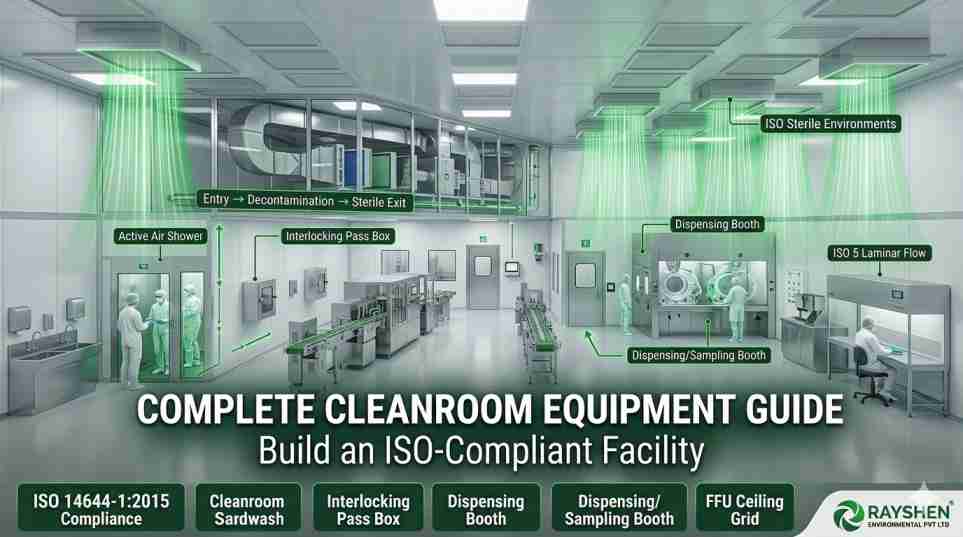
Fan Filter Units (FFU): The engine of the cleanroom. For a Portable Cleanroom Enclosure, these units sit on the ceiling, drawing in air, passing it through HEPA/ULPA filters, and pushing it downward in a laminar flow.
HEPA/ULPA Filters: To reach ISO Class 5 Clean Room standards, filters must be H14 or U15 grade, capable of removing 99.995%+ of particles.
Return Air Risers: These ensure air is pulled back to the HVAC system efficiently, preventing "dead zones" where particles can settle.
3. Entry and Decontamination Systems
Contamination is most likely to enter through the door. Specialized clean room equipment acts as a buffer between the sterile zone and the outside world.
Air Showers: A high-velocity "scrubbing" chamber that blows loose particles off personnel before they enter. Every high-spec Portable Cleanroom Enclosure should be equipped with an integrated air shower.
Pass Boxes (Static & Dynamic): These allow for the transfer of materials into the cleanroom without personnel movement. Dynamic pass boxes include built-in UV lights and HEPA filtration for added safety.
Gowning Room Furniture: Stainless steel cross-over benches, garment cabinets, and specialized shoe racks are essential to keep the "gray zone" organized and compliant.
4. Monitoring and Control Systems
You cannot manage what you do not measure. A compliant facility requires real-time data.
Particle Counters: Handheld or fixed sensors that provide an instant readout of the particle count per cubic meter.
Pressure Differential Gauges: These ensure the cleanroom maintains "Positive Pressure," forcing air out of the room when a door is opened, rather than letting dirty air in.
BMS/PLC Controls: An integrated Cleanroom Booth Manufacturer like Rayshen provides control panels that allow you to adjust fan speeds and monitor filter health from a single touch-screen.
5. Specialized Cleanroom Furniture
Standard office or laboratory furniture is banned in a clean room because it sheds particles.
Stainless Steel Worktables: SS304 tables with perforated tops allow for laminar airflow to pass through the work surface rather than creating turbulence.
Anti-Static (ESD) Chairs: Essential for electronics assembly to prevent static discharge that can ruin sensitive components.
Why Partner with a Cleanroom Booth Manufacturer?
Building a facility by sourcing individual parts from different vendors often leads to "integration failure"—where the FFU doesn't fit the ceiling grid or the air shower isn't timed to the door interlocks.
By working with a single Cleanroom Booth Manufacturer, you receive a turnkey solution. At Rayshen, we provide the engineering expertise to calculate the exact Softwall Cleanroom Price for your specific square footage while ensuring your Portable Cleanroom Enclosure meets the rigorous demands of ISO audits.
Conclusion: Investing in Compliance
Building a clean room is a long-term investment in your product’s quality. From the high-velocity air shower to the precision of an ISO Class 5 Clean Room filter, every piece of equipment plays a role in your success.
Ready to start your build? Rayshen is your expert partner in India and across the globe. Contact us today for a full equipment list and a custom quote.
[Request a Detailed Quote for Your Cleanroom Project]
1.What is the main difference between hardwall and softwall cleanrooms?
Hardwall (Modular) booths offer better pressure control and are easier to clean for pharmaceutical use. Softwall enclosures are more cost-effective and portable, ideal for electronics or localized zones.2.How do I determine the number of FFUs needed for an ISO Class 5 Clean Room?
ISO 5 requires 60% to 80% ceiling coverage. As a Cleanroom Booth Manufacturer, we calculate this based on your room volume and required air changes per hour (ACH).Is a pass box necessary for all cleanrooms? Yes. A pass box significantly reduces contamination by allowing materials to move in and out without personnel having to de-gown and re-gown.
3.What factors influence the Softwall Cleanroom Price?
The main drivers are the frame material (Aluminum vs. Stainless Steel), the type of PVC curtain (Standard vs. Anti-static), and the number of HEPA/FFU units required for your target ISO class.4.Can a Portable Cleanroom Enclosure be upgraded later?
Most modular designs from Rayshen are "future-proof." You can add more FFUs or expand the paneling as your production needs grow.5.What is the lifespan of HEPA filters in a clean room?
With proper pre-filtration, a high-quality HEPA filter typically lasts 2 to 5 years. Regular validation and monitoring of pressure gauges are essential to determine the exact replacement time.
.png)
.png)