The Ultimate Guide to HEPA Filters: Standards, Industrial Applications, and Maintenance (2026 Edition)
19-12-2025
In an era where air quality dictates the success of high-precision industries—from pharmaceutical manufacturing to semiconductor assembly—the HEPA filter has evolved from a specialized component to an absolute necessity. Whether you are managing an ISO-certified cleanroom or optimizing a hospital’s HVAC system, understanding the technical nuances of High-Efficiency Particulate Air (HEPA) technology is the first step toward operational excellence.
At Rayshen Environmental, we have spent years engineering filtration solutions that do more than just "clean the air." We design systems that ensure regulatory compliance, protect multi-million dollar product batches, and safeguard human health. This guide provides a comprehensive look at how HEPA filters work, the critical differences between H13 and H14 grades, and how to choose the right configuration for your specific facility.
What Exactly is a HEPA Filter? (The Technical Reality)
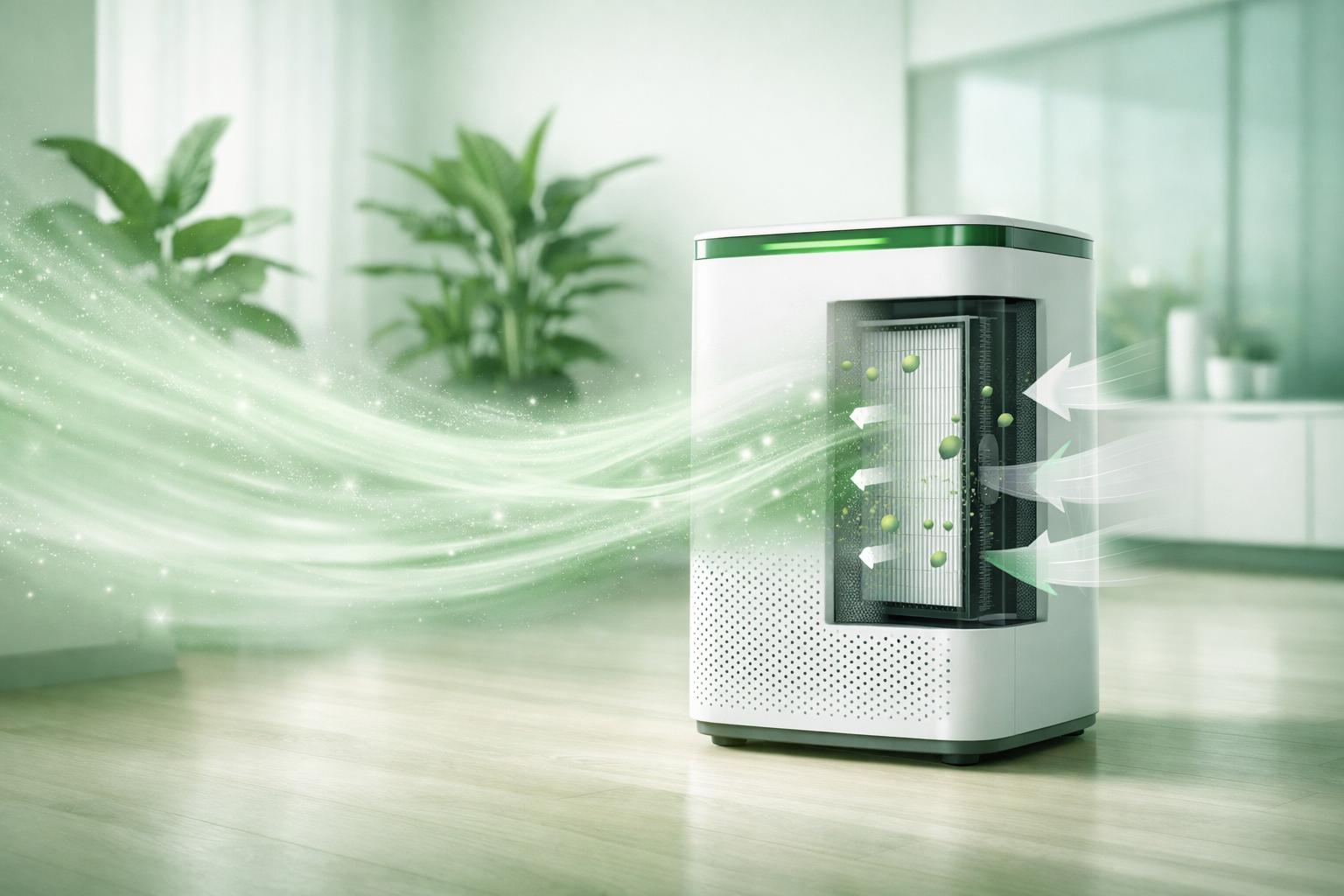
A common misconception is that a HEPA filter is simply a dense mesh. In reality, it is a scientifically engineered matrix of micro-glass fibers. Unlike standard filters that rely on a "sieving" effect, HEPA filters utilize a complex set of physical mechanics to achieve 99.97% to 99.995% efficiency.
The 0.3-Micron Benchmark and MPPS
Why is 0.3 microns the standard for testing? In the world of filtration, this is known as the Most Penetrating Particle Size (MPPS). Particles larger than this are easy to catch through inertia, and particles smaller are actually easier to catch through Brownian motion (diffusion). The 0.3-micron particle is the "sneakiest," and if a filter can stop it, it can stop almost anything else.
The Physics of How HEPA Filters Work
To understand the reliability of a Rayshen HEPA filter, you must look at the four ways it traps contaminants:
Sieving: The most basic method where particles are simply too large to pass through the gaps in the glass fibers.
Interception: Mid-sized particles follow the air stream but come close enough to a fiber to "stick" to it through molecular attraction.
Inertial Impaction: Larger, heavier particles possess too much momentum to follow the air's curving path around a fiber. Instead, they crash directly into the fiber and become trapped.
Diffusion (Brownian Motion): The smallest particles move in a zig-zag, erratic pattern due to collisions with gas molecules. This erratic movement increases the probability that they will eventually hit a fiber and adhere to it.
HEPA Filter Classifications: EN 1822 vs. ISO 29463 Standards
When purchasing industrial filters in India or globally, you will encounter two main standards. At Rayshen, we adhere strictly to EN 1822, which is the European gold standard for high-efficiency filters.
The H13 vs. H14 Comparison
H13 HEPA Filter: Rated for 99.95% efficiency. It is the workhorse of the industry, ideal for general hospital wards, advanced office HVAC, and food processing secondary zones.
H14 HEPA Filter: Rated for 99.995% efficiency. This is considered medical-grade or cleanroom-grade. It is mandatory for aseptic filling suites in pharma and Class 100 semiconductor labs.
Filter Grade Efficiency at MPPS Local Leakage Limit 
H13 99.95% 0.25%
H14 100.00% 0.03%
Mini-Pleat vs. Deep-Pleat: Which Geometry Do You Need?
The way a filter is folded (pleated) significantly impacts its performance and the energy bill of your facility.
The Mini-Pleat Advantage
Our Mini-Pleat HEPA filters represent the latest in filtration technology. Instead of using bulky aluminum separators, we use hot-melt beads to separate the pleats.
Why it matters: This allows for a much higher density of filter media in a smaller frame.
The Benefit: More surface area equals a lower initial pressure drop, meaning your fans don't have to work as hard to push air through, saving you 15-20% in energy costs annually.
Deep-Pleat Filters for High Volume
For traditional Air Handling Units (AHUs) with high air volumes, Deep-Pleat filters with corrugated aluminum separators provide the structural rigidity needed to prevent media "flutter" at high velocities.
Industrial Applications: Where Air Purity is Non-Negotiable
Pharmaceutical & Biotechnology
In drug manufacturing, a single airborne microbe can lead to a "batch failure," costing millions. Rayshen’s H14 gel-seal filters are used in:
Sterile Filling Lines: Ensuring ISO 5 environments.
Biosafety Cabinets: Protecting researchers from hazardous pathogens.
Depyrogenation Tunnels: High-temperature HEPA filters that withstand up to 250°C.
Semiconductor & Electronics
As technology moves toward smaller nanometer nodes, dust is the ultimate enemy. Even a particle at 0.1 microns can cause a short circuit on a silicon wafer. Our ULPA (Ultra-Low Penetration Air) filters are designed specifically for these "Class 1" environments.
Healthcare & Hospitals
Post-pandemic, hospital air management has changed. We provide HEPA solutions for:
Positive Pressure Rooms: Keeping contaminants out of immunocompromised patient areas.
Negative Pressure Isolation Wards: Ensuring infectious air is filtered through HEPA before being exhausted outside.
Maintenance and Integrity Testing: DOP/PAO Explained
A HEPA filter is only as good as its installation. Even a 99.99% efficient filter is useless if air "bypasses" it through a leaky gasket.
The Importance of DOP/PAO Testing
After installation, and at least once a year, every industrial filter should undergo Integrity Testing. We use an aerosol (like PAO - Polyalphaolefin) to "challenge" the filter. A technician scans the downstream side with a photometer to ensure no leaks are present in the media or the frame seals.
Protecting Your Investment with Pre-Filtration
You should never use a HEPA filter as a standalone unit. To maximize the life of your expensive HEPA (often 2-3 years), you must use a multi-stage approach:
Primary Stage (G4/EU4): Catches large dust and lint.
Secondary Stage (F7/F9): Catches smaller fine dust.
Final Stage (HEPA): Does the heavy lifting for sub-micron particles.
Why Rayshen is the Preferred Partner for Cleanroom Air Quality
At Rayshen Environmental, we don't just manufacture filters; we provide compliance.
Individual Certification: Every filter is tested in our factory as per EN 1822 and comes with its own unique test report.
Custom Dimensions: Whether you have an old imported AHU or a brand-new cleanroom, we manufacture custom-sized HEPA filters to fit your existing housings.
Prompt Support: Based in India, we offer the shortest lead times and on-site technical support for filter validation.
.png)
.png)