Future-Proofing Your Lab: Scaling from ISO 8 to ISO 5 with Modular FFU Grids
22-04-2026
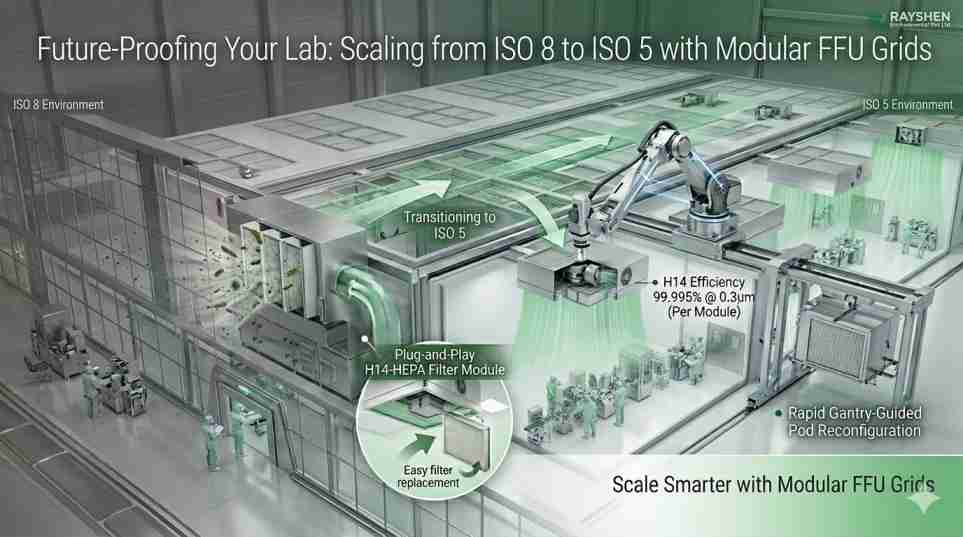
In the fast-evolving landscape of 2026, scientific and industrial requirements can change overnight. A laboratory that begins as an ISO 8 (Class 100,000) space for general assembly may suddenly need to upgrade to ISO 5 (Class 100) to accommodate high-precision semiconductor work or aseptic pharmaceutical filling.
Traditionally, this upgrade would require a total facility shutdown, massive HVAC ductwork demolition, and a multi-million rupee reinvestment. However, the rise of Modular Fan Filter Unit (FFU) Grids has changed the rules. At Rayshen, we specialize in "Future-Proof" cleanroom engineering, allowing facilities to scale their cleanliness levels with surgical precision and minimal downtime.
1. Understanding the ISO 14644-1 Hierarchy
To scale effectively, one must understand the mathematical leap between cleanroom classes. The difference between ISO 8 and ISO 5 isn't just a minor improvement—it is a 1,000-fold reduction in particulate concentration.
| Cleanroom Class | Particles (≥0.5μm) per m3 | Air Changes Per Hour (ACH) | FFU Ceiling Coverage
|
| ISO 8 | 3,520,000 | 20 – 30 | 5% – 15% |
| ISO 7 | 352,000 | 60 – 90 | 15% – 25% |
| ISO 6 | 35,200 | 150 – 240 | 25% – 40% |
| ISO 5 | 3,520 | 240 – 480 | 35% – 70% |
As the table shows, moving from ISO 8 to ISO 5 requires a massive increase in filtered air volume. The only cost-effective way to achieve this without rebuilding your entire HVAC system is through a modular grid of Rayshen FFUs.
2. The Modular FFU Grid: The Building Blocks of Scalability
A "Fixed" HVAC system (Centralized AHU) is like a desktop computer with a soldered motherboard—it cannot be upgraded. A Modular FFU Grid is like a high-end server; you simply "plug in" more processing power when you need it.
What is a Modular Ceiling Grid?
Instead of a solid drywall ceiling, a future-proof lab uses a 2' x 4' (610mm x 1220mm) T-Bar Grid system.
Initial Phase (ISO 8): You might install 5 FFUs and fill the rest of the grid with blanking panels and LED lights.
Scaling Phase (ISO 5): When the requirement changes, you simply remove the blanking panels and drop in additional Rayshen Fan Filter Units. No new ductwork is required.
3. Engineering the Jump: How to Scale from ISO 8 to ISO 5
Moving through the ISO classes requires more than just "more fans." It requires a shift in airflow dynamics.
From Turbulent to Laminar Flow
In an ISO 8 lab, airflow is usually "turbulent"—air is mixed to dilute contaminants. However, at ISO 5, you must achieve Laminar (Unidirectional) Airflow.
The Rayshen Solution: By increasing FFU density to 70% ceiling coverage, air moves in a uniform "piston" from the ceiling to the floor, pushing all particles out through low-level returns before they can settle on sensitive work surfaces.
The Role of EC Motor Technology
Scaling from ISO 8 to ISO 5 means you might be tripling the number of fans. If you use legacy AC motors, your energy bill and heat load will skyrocket.
2026 Standard: Rayshen’s EC (Electronically Commutated) FFUs are essential for scaling. They are 70% more efficient than AC motors and generate significantly less heat, ensuring your cooling system isn't overwhelmed as you increase filtration power.
4. Managing the "Pressure Cascade" During Expansion
As you increase the number of FFUs to reach ISO 5, the internal air pressure of the lab will rise. This is vital for preventing "Infiltration" from dirtier surrounding areas.
Active Pressure Control: Rayshen FFUs can be linked to a central Control System (BMS). As you add more units, the system automatically balances the fan speeds to maintain the specific pressure differential (usually +15 to +30 Pascals) required for compliance.
Internal Zoning: With a modular grid, you can create a "Mini-Environment." You can scale one specific corner of your lab to ISO 5 for critical work while keeping the rest of the room at ISO 7, saving thousands in operational energy.
5. Maintenance and Room-Side Replaceability (RSR)
As a lab scales, maintenance becomes more frequent. You cannot afford to take down the entire ceiling to change a filter.
RSR Technology for ISO 5 Success
Rayshen’s RSR FFUs allow technicians to replace the HEPA/ULPA filter from inside the room.
No need to climb into the "dirty" crawl space above the ceiling.
No risk of breaking the sterile seal of the ceiling grid.
Filter changes take 15 minutes instead of 4 hours.
6. Frequently Asked Questions (FAQs)
Q1: Can I mix HEPA and ULPA filters in the same grid?
Yes. During the scaling process, you might use H14 HEPA filters for the general ISO 7 area and U15 ULPA filters for the ISO 5 critical workstations. Rayshen FFUs are compatible with both media types.
Q2: How do I handle the extra heat from more fans?
By using EC motors, heat dissipation is minimized. Additionally, our FFUs are designed with aerodynamic fan housings that reduce friction, further lowering the thermal load on your chilled water or DX cooling system.
Q3: Is a modular grid airtight enough for ISO 5?
Absolutely. Rayshen uses specialized gasket-seal or gel-seal T-bar grids. When the FFU is dropped into the grid, the weight of the unit (or a mechanical clamp) creates a hermetic seal that prevents air bypass.
7. Conclusion: Build for the Future, Not Just for Today
The most expensive cleanroom is the one that cannot grow with your business. In 2026, the ability to scale from ISO 8 to ISO 5 is a competitive advantage. By investing in a Modular FFU Grid from Rayshen, you are ensuring that your facility remains compliant, energy-efficient, and ready for whatever the next scientific breakthrough requires.
Are you planning a lab that needs to grow?
Contact Rayshen Today for a Modular Grid Design & Technical FFU Quote
.png)
.png)