Fan Filter Unit (FFU): Working Principle, Types, and How to Choose the Right One for Your Cleanroom
18-08-2026
If you've ever walked into a semiconductor fab or a pharmaceutical aseptic filling area and looked up, chances are you were standing beneath a ceiling grid of Fan Filter Units (FFUs). These self-contained units are the workhorses behind unidirectional (laminar) airflow cleanrooms, continuously drawing in room air, filtering it through a HEPA or ULPA media, and delivering a steady, particle-free stream back into the controlled space.
This guide covers what a Fan Filter Unit is, how it works, the different configurations available, and the key factors to evaluate before specifying FFUs for your facility.
What Is a Fan Filter Unit (FFU)?
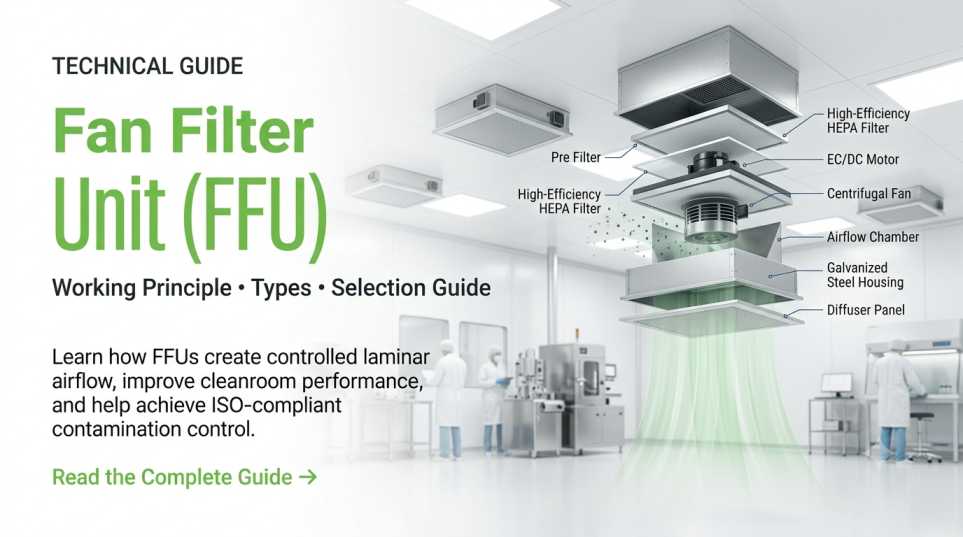
A Fan Filter Unit is a self-contained air filtration module that integrates a motorized fan, a plenum for airflow distribution, and a HEPA or ULPA filter into a single ceiling-mounted or free-standing unit. Unlike centralized AHU systems that push filtered air through extensive ductwork, FFUs filter air locally and independently — making them modular, scalable, and easier to maintain in mission-critical cleanroom environments.
FFUs are the backbone of unidirectional airflow cleanrooms, most commonly found in ISO Class 5 and cleaner environments where consistent, downward laminar airflow is required to sweep particulates away from critical work zones.
How a Fan Filter Unit Works
The operating principle of an FFU is straightforward but precisely engineered:
Intake – Room air is drawn into the top of the unit through a pre-filter, which captures larger particles and extends the life of the primary HEPA/ULPA filter.
Pressurization – A motorized fan (typically an EC motor) pressurizes the internal plenum, distributing air evenly across the entire filter face.
Filtration – Air passes through the HEPA (H13/H14) or ULPA filter, where sub-micron particles are captured via interception, impaction, diffusion, and sieving.
Discharge – Clean, filtered air exits the unit in a uniform, unidirectional downward flow, maintaining the classified cleanliness level of the space beneath it.
Why EC Motor Technology Matters
Modern FFUs, including those manufactured by Rayshen Environmental, use EC (Electronically Commutated) motor technology instead of older AC motor designs. EC motors offer:
Significantly lower energy consumption (often 40-60% less than comparable AC motors)
Precise, steplessly variable airflow control via built-in or external controllers
Lower operating noise levels, important for occupied cleanroom spaces
Longer operational lifespan with reduced maintenance requirements
Given that FFUs typically run 24/7 in production environments, the cumulative energy savings from EC motor technology translate into substantial operational cost reductions over the unit's lifecycle.
Types of Fan Filter Units
Ceiling-Mounted FFUs
The most common configuration, these units are installed directly into the cleanroom's false ceiling grid, forming a continuous or partial canopy of filtered airflow across the work zone. Ceiling coverage percentage (the ratio of FFU area to total ceiling area) directly determines achievable ISO classification.
Standalone / Portable FFUs
Used for localized clean zones, mobile workstations, or temporary cleanroom setups where a fixed ceiling installation isn't practical. These units are self-supporting and can be relocated as production needs change.
Low-Noise and High-Capacity Variants
Specialized FFU variants are available for applications requiring either minimal acoustic disruption (hospital OTs, research labs) or higher airflow volumes (high-occupancy or high-heat-load cleanrooms).
Fan Filter Units and Cleanroom Classification (ISO 14644)
The number, placement, and filtration grade of FFUs in a given space directly determine the achievable ISO 14644 cleanroom classification:
ISO Class 5 and cleaner (semiconductor, aseptic pharmaceutical filling) typically require 80-100% ceiling coverage with H14 or ULPA-grade FFUs.
ISO Class 6-7 environments can often achieve compliance with partial ceiling coverage and H13-grade filtration.
ISO Class 8 spaces may use FFUs more selectively, often supplementing a centralized AHU system rather than relying on FFUs exclusively.
Getting this ratio right during the design phase is critical — under-specifying FFU coverage can prevent a facility from achieving its target classification, while over-specifying adds unnecessary capital and energy cost.
Why Industries Rely on Fan Filter Units
Semiconductor and Electronics Manufacturing
Semiconductor fabs represent the most demanding FFU application, often requiring near-total ceiling coverage with ULPA-grade filtration to maintain ISO Class 1-5 environments where even nanometer-scale particles can cause wafer defects.
Pharmaceutical and Biotechnology
Aseptic filling lines, isolators, and RABS (Restricted Access Barrier Systems) commonly use FFUs to maintain localized ISO Class 5 zones over critical filling points, supporting GMP compliance without requiring the entire room to meet that classification.
Hospitals — OT and CSSD
Operation theatres increasingly use FFU-based laminar airflow canopies positioned directly over the operating table, reducing airborne contamination risk during surgical procedures.
Laboratories and Research Facilities
Biosafety labs and research cleanrooms use FFUs to create localized clean zones for sensitive sample handling and experimental work without the cost of full-room HEPA filtration.
The Direct Manufacturer Advantage for FFUs
Sourcing FFUs from a direct manufacturer rather than a trading company offers meaningful advantages, particularly for validated environments:
Factory-tested airflow uniformity: Every unit is tested for consistent face velocity and filter integrity before dispatch, not just spot-checked.
Customization capability: Non-standard sizes, motor specifications, controller integration (BMS-compatible), and housing materials can be built to project drawings.
Full documentation support: Complete IQ/OQ/PQ validation documentation, DOP/PAO test certificates, and motor performance data are provided to support facility audits and regulatory submissions.
Direct factory pricing: Without reseller markups, project-based and bulk FFU procurement becomes significantly more cost-effective.
As a direct manufacturer, Rayshen Environmental produces FFUs in-house — from housing fabrication and EC motor integration to final HEPA/ULPA filter installation and testing — giving buyers full traceability and control over specifications.
How to Choose the Right Fan Filter Unit
When specifying FFUs for a new or upgraded cleanroom, evaluate the following:
Target ISO 14644 classification – Determines required filter grade (H13/H14/ULPA) and ceiling coverage percentage.
Motor type and controllability – EC motors offer better energy efficiency and airflow control than legacy AC motor designs.
Noise tolerance – Occupied spaces like hospital OTs and labs may require low-noise FFU variants.
BMS/controller integration – Facilities with centralized building management systems should confirm FFU compatibility with existing monitoring infrastructure.
Filter replacement accessibility – Consider maintenance access requirements, especially for ceiling-mounted units in continuously operating facilities.
Documentation requirements – Regulated industries (pharma, biotech) should confirm IQ/OQ/PQ and validation documentation are available from the manufacturer.
FFU Maintenance and Performance Monitoring
To sustain design performance over time, facilities should implement:
Regular filter differential pressure monitoring to track loading and predict replacement schedules
Periodic DOP/PAO leak testing to confirm filter integrity and seal performance
Airflow velocity verification to ensure continued compliance with unidirectional flow requirements
Motor performance checks, particularly for EC motor units, to confirm consistent RPM and airflow output over the unit's operational life
Conclusion
Fan Filter Units are a foundational component of modern unidirectional airflow cleanrooms, offering a modular, energy-efficient, and scalable alternative to purely ducted AHU-based filtration. From semiconductor fabs demanding ULPA-grade purity to pharmaceutical aseptic zones and hospital operation theatres, the right FFU specification directly impacts both contamination control and long-term operational cost.
As a direct manufacturer of Fan Filter Units in India, Rayshen Environmental builds EC motor-driven FFUs with HEPA/ULPA filtration, custom sizing, and complete IQ/OQ/PQ documentation — supporting pharmaceutical, semiconductor, healthcare, and laboratory customers with factory-tested performance and full validation support.
Planning a cleanroom upgrade or new FFU installation? Connect with Rayshen Environmental's technical team for FFU specifications, ceiling coverage calculations, and a detailed project quotation.
Related post
- FFUs in Semiconductor and Pharmaceutical Cleanrooms: Why They're Essential
- The Future of Cleanroom Airflow: The Ultimate Guide to Fan Filter Units (FFU) by Rayshen Environmental Private Limited
- The Ultimate Fan Filter Unit (FFU) Buying Guide 7 Things You Must Check Before Purchasing
- How Many Fan Filter Units Do You Need?
- Ultimate Guide to Fan Filter Units
.png)
.png)