Clean Room Equipment: A Complete Buyer's Guide to Building a Compliant Controlled Environment
18-08-2026
Setting up a cleanroom is rarely a single-product purchase — it's a system of interdependent equipment that must work together to achieve and sustain a specific ISO cleanliness classification. Get one component wrong, whether it's undersized filtration or a missing contamination checkpoint, and the entire facility can fail to meet its target classification or regulatory requirement.
This guide walks through the core categories of clean room equipment, how each component contributes to overall contamination control, and what to evaluate when sourcing equipment for a new build or facility upgrade.
What Counts as Clean Room Equipment?
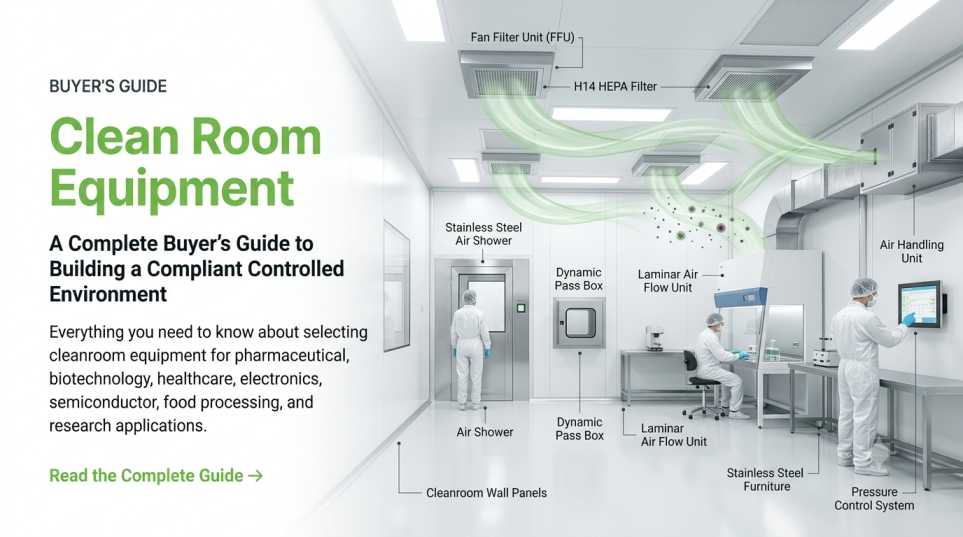
Clean room equipment refers to the full range of specialized systems and components required to create, maintain, and control a classified environment under standards like ISO 14644 and, where applicable, GMP guidelines. This spans air filtration systems, airflow delivery units, contamination-control entry points, material transfer systems, and the structural/furniture elements that make up the cleanroom envelope itself.
Broadly, clean room equipment falls into several functional categories:
1. Air Filtration Systems — HEPA and ULPA Filters
At the core of every cleanroom is its filtration system. HEPA filters capture 99.97% of particles at 0.3 microns and are graded under EN 1822 as H13 or H14 depending on required efficiency, while ULPA filters push efficiency even higher for ISO Class 5 and cleaner semiconductor or nanotechnology applications.
Filters are typically constructed using Mini Pleat designs to maximize filtration area within a compact frame, reducing pressure drop and extending service life — an important consideration for facilities running continuous operations.
2. Airflow Delivery — Fan Filter Units (FFUs)
Fan Filter Units combine a HEPA/ULPA filter with a motorized fan in a single ceiling-mounted or standalone module, delivering localized, unidirectional (laminar) airflow without relying entirely on centralized ductwork. Modern FFUs use EC motor technology for lower energy consumption and precise airflow control — a meaningful factor given that FFUs typically run continuously in production environments.
The ratio of FFU ceiling coverage to total ceiling area directly determines what ISO classification a space can achieve, making FFU specification one of the most consequential decisions in cleanroom design.
3. Contamination Control Entry Points — Air Showers and Pass Boxes
Air Showers
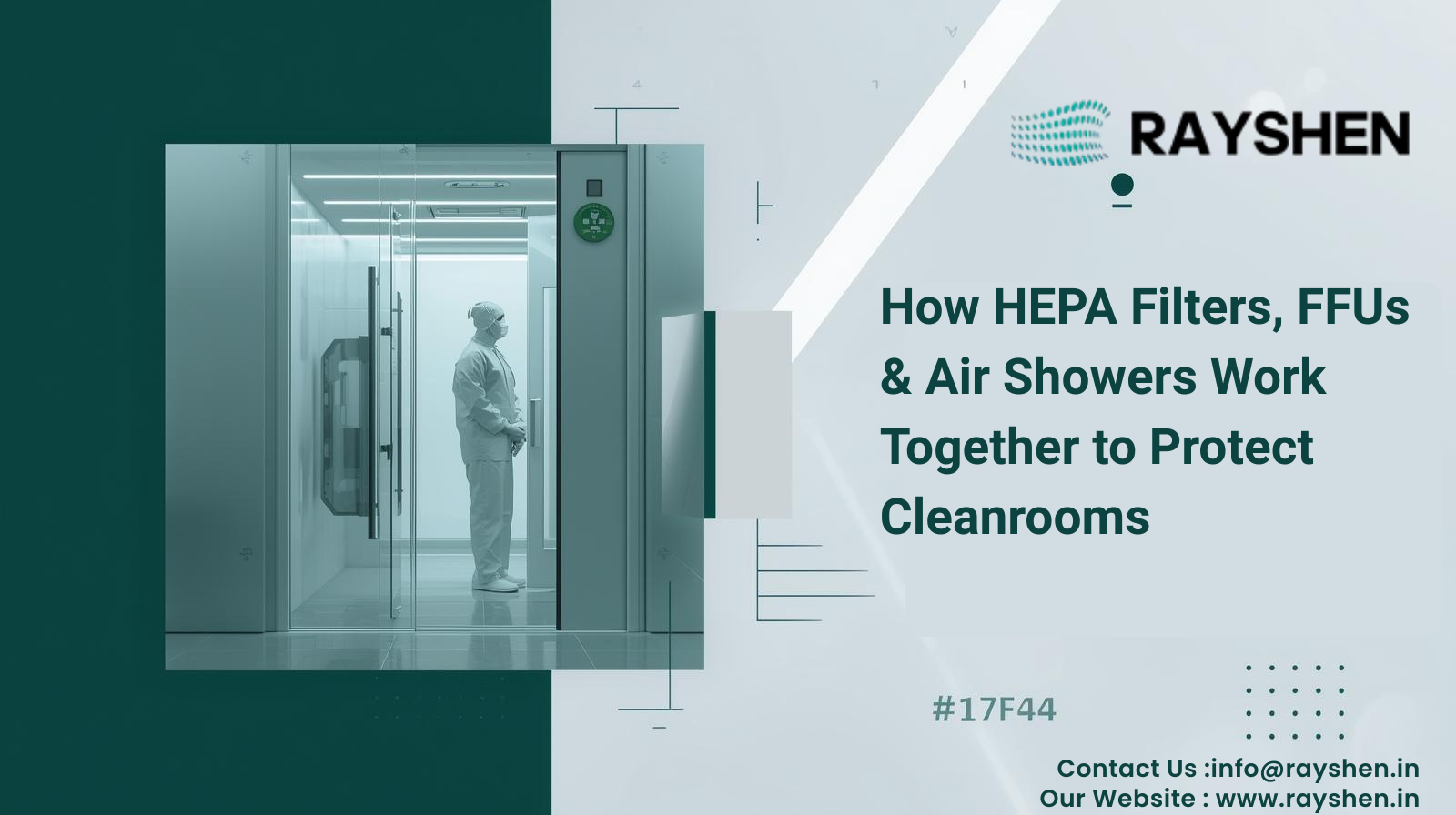
Air showers are enclosed chambers positioned at cleanroom entry points that use high-velocity HEPA-filtered air jets to remove loose particulate contamination from personnel or materials before entry. Interlock door systems ensure both doors can never be open simultaneously, preventing unfiltered air from bypassing the decontamination cycle.
Pass Boxes
Pass boxes allow materials to move between classified and unclassified areas (or between two different classification zones) without requiring full personnel entry. Static pass boxes rely on interlock mechanisms alone, while dynamic (or "active") pass boxes incorporate HEPA filtration and airflow to actively decontaminate the transfer chamber — typically required for higher-classification pharmaceutical and biotech applications.
4. Structural and Workspace Equipment — Clean Room Booths
Clean room booths provide localized, self-contained controlled environments — often used for specific processes like spray painting, assembly, or packaging — without requiring an entire room to meet a stringent classification. Booths typically integrate HEPA filtration, lighting, and sometimes FFUs directly into a modular enclosure, offering a cost-effective alternative to full-room cleanroom construction for process-specific applications.
How These Components Work Together
A functioning cleanroom isn't a collection of standalone products — it's an integrated system:
HEPA/ULPA filters establish the baseline filtration efficiency required for the target ISO classification.
FFUs distribute that filtered air as unidirectional laminar flow across the critical work zone.
Air showers prevent personnel from introducing contamination at the entry point.
Pass boxes allow material transfer without compromising the controlled environment's integrity.
Clean room booths extend controlled conditions to specific processes without full-room-level investment.
Specifying any one component in isolation — without considering how it interacts with the others — is one of the most common causes of cleanrooms failing to achieve or sustain their target classification during validation.
Clean Room Equipment by Industry Application
Pharmaceutical Manufacturing
GMP-compliant facilities require a full equipment stack — HEPA-filtered AHUs or FFUs, air showers at gowning transitions, and dynamic pass boxes for material transfer — supported by complete IQ/OQ/PQ documentation for regulatory submission.
Semiconductor and Electronics
Fabs demand near-total FFU ceiling coverage with ULPA-grade filtration, often supplemented by cargo air showers for equipment and material carts moving into ISO Class 5 and cleaner zones.
Hospitals — OT, ICU, and CSSD
Operation theatres rely on laminar airflow canopies (FFU-based) directly over the surgical table, paired with air showers and pass boxes at CSSD material transfer points to reduce infection risk.
Biotechnology and Laboratories
Research and biosafety facilities combine HEPA filtration, FFUs, and pass boxes to protect sensitive experiments while maintaining containment protocols for hazardous materials.
Food Processing and Aerospace
Food manufacturing uses clean room equipment to control microbial contamination in sensitive packaging zones, while aerospace facilities rely on similar systems to protect precision components from particulate damage during assembly.
Why Source Clean Room Equipment From a Direct Manufacturer
Sourcing an entire equipment stack from a direct manufacturer rather than multiple trading companies offers substantial advantages:
System-level compatibility: Filters, FFUs, air showers, and pass boxes designed and manufactured together are easier to integrate and commission than equipment sourced piecemeal from unrelated suppliers.
Factory-tested performance: Every unit — from filter MPPS efficiency to FFU airflow uniformity — is tested before dispatch, not sampled in batches.
Customization capability: Non-standard dimensions, materials, and control integration can be manufactured to project drawings across the entire equipment range.
Full documentation support: Complete IQ/OQ/PQ validation documentation is provided across all equipment categories, simplifying facility-wide qualification and audit preparation.
Single point of accountability: Working with one direct manufacturer for the full equipment stack reduces coordination overhead and clarifies warranty and support responsibility compared to managing multiple vendors.
As a direct manufacturer, Rayshen Environmental produces HEPA/ULPA filters, Fan Filter Units, air showers, pass boxes, and clean room booths in-house, giving facilities a single, accountable source for their complete cleanroom equipment requirement.
How to Plan a Clean Room Equipment Procurement
Define your target ISO 14644 classification – This drives filtration grade, FFU coverage percentage, and entry-point contamination control requirements.
Map personnel and material flow – Determines air shower sizing/configuration and pass box placement between zones.
Identify process-specific needs – Determine whether standalone clean room booths can reduce full-room investment for specific operations.
Confirm documentation requirements – Regulated industries should verify IQ/OQ/PQ, DOP/PAO test reports, and material certifications are available before procurement.
Evaluate long-term operating cost – Factor in EC motor energy savings, filter replacement intervals, and maintenance accessibility across the full equipment lifecycle.
Conclusion
Clean room equipment is a system, not a shopping list — and treating it that way from the design stage forward is what separates facilities that pass validation smoothly from those that face costly rework. From HEPA/ULPA filtration and FFU airflow delivery to air showers, pass boxes, and process-specific booths, each component plays a defined role in achieving and sustaining a target ISO classification.
As a direct manufacturer of clean room equipment in India, Rayshen Environmental supports pharmaceutical, semiconductor, healthcare, biotechnology, food processing, and aerospace customers with factory-tested equipment, customization capability, and complete IQ/OQ/PQ documentation across the full product range.
- Planning a new cleanroom build or facility upgrade? Connect with Rayshen Environmental's technical team for a complete equipment assessment and project quotation.
Related post
- Complete List of Cleanroom Equipment: Everything You Need to Build a Compliant Facility
- Clean Room Equipment 101: HEPA Filters, FFUs, Air Showers, and More
- The Comprehensive Guide to Clean Room Technology: Sizing, ISO Standards, and Modern Modular Cleanroom India Solutions
- What Is a Clean Room? A Complete Beginner’s Guide for Modern Industries
- The Future of Cleanroom Airflow: The Ultimate Guide to Fan Filter Units (FFU) by Rayshen Environmental Private Limited
- Clean Room Equipment: The Detailed Guide for Modern Controlled Environments
- Complete List of Cleanroom Equipment: Everything You Need to Build a Compliant Facility
.png)
.png)