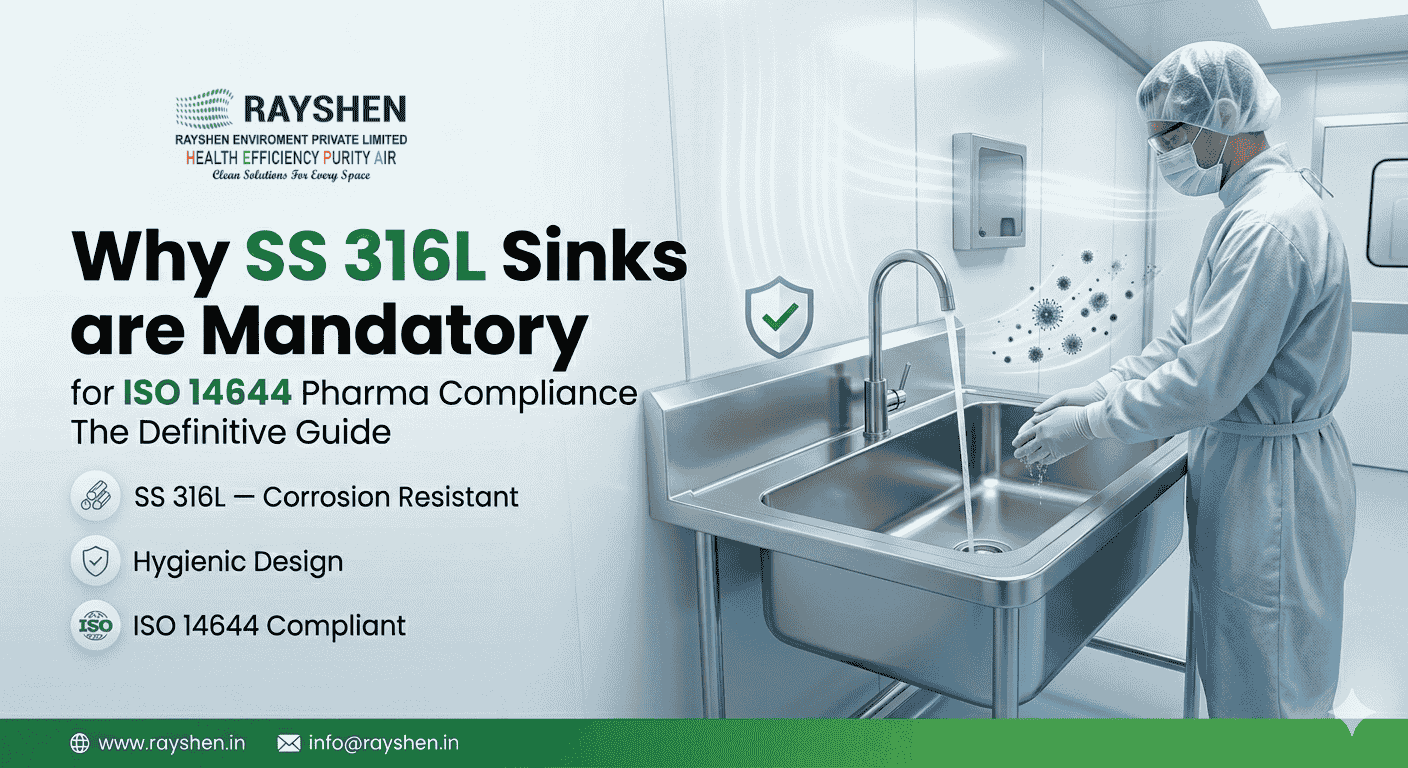
Why SS 316L Sinks are Mandatory for ISO 14644 Pharma Compliance: The Definitive Guide
03-04-2026
In the pharmaceutical manufacturing sector, the "environment" is a critical raw material. Just as active pharmaceutical ingredients (APIs) must be pure, the air and surfaces they interact with must be inert. While most facility managers focus heavily on HEPA filtration, the physical hardware of the "grey zones" and "clean zones"—specifically the SS Sink—is often where audits are won or lost.
As a premier cleanroom equipment manufacturer, Rayshen has observed a shift in global regulatory expectations. Standard "industrial" stainless steel is no longer enough. This guide explains why SS 316L is the non-negotiable standard for ISO 14644 compliance in 2026.
1. The Regulatory Landscape: ISO 14644 and Beyond
ISO 14644-1 focuses on air particulate cleanliness, but ISO 14644-5 (Operations) and ISO 14644-9 (Surface Cleanliness) explicitly demand that equipment must not contribute to the contamination of the space.
The "Non-Shedding" Mandate
In a Grade A or B cleanroom, surfaces must be "non-shedding." Lower grades of steel, when exposed to the high-frequency cleaning cycles of a Pharma plant, can undergo microscopic surface erosion. This erosion releases metallic ions and particulates into the air. SS Sinks from Rayshen are electropolished to ensure a surface roughness (Ra) of < 0.8 µm, preventing particle shedding.
Bio-Burden and the "Biofilm" Threat
The primary enemy of ISO compliance is the biofilm. When water sits on a surface that has even minor pitting (common in SS 304), bacteria like Staphylococcus and E. coli create a protective matrix. Standard wiping cannot remove a biofilm once it anchors in a corrosion pit. The molybdenum content in 316L prevents these pits from forming in the first place.
2. Metallurgy Deep Dive: Why "316L" and not "304"?
To understand why Rayshen insists on 316L, we must look at the chemical composition of the alloy.
The Role of Molybdenum (Mo)
SS 304 contains 18% Chromium and 8% Nickel. SS 316L adds 2% to 3% Molybdenum. This single addition changes the electrochemical behavior of the sink. In the presence of chlorides (found in many tap waters and industrial disinfectants), 304 undergoes "pitting." Molybdenum acts as a "sealant" at the molecular level, stabilizing the passive chromium-oxide layer.
Understanding the "L" (Low Carbon) Advantage
During the welding process of a scrub sink, high heat can cause carbon to react with chromium, forming chromium carbides. This "sensitization" leaves the area around the weld vulnerable to rust. By using 316L (Low Carbon), Rayshen ensures that the welded joints of your sink are just as corrosion-resistant as the main basin.
3. Engineering the Perfect Pharma Scrub Sink
A sink in a hospital or pharma unit is an engineering tool, not a piece of furniture. Rayshen integrates several "High-Value" features to ensure long-term ROI.
Coved Corners (Radius R20 to R50)
Sharp 90-degree angles are the "graveyards" of hygiene. Dirt and moisture trap in corners, becoming a breeding ground for fungi. All Rayshen SS Sinks feature deep-drawn or fabricated basins with coved (rounded) corners. This allows a simple wipe-down to achieve 100% surface sterilization.
Sloped Surfaces and Anti-Splash Backsplashes
Water stagnation is a violation of GMP (Good Manufacturing Practices). Our sinks are designed with a 5-degree pitch towards the drain. Furthermore, the high-rise backsplashes are integrated (not bolted) to the sink body to prevent water from seeping behind the unit into the wall cavity—a common site for hidden mold growth.
4. Hands-Free Technology: Stopping Cross-Contamination
In an ISO 5 environment, a technician's hands must never touch a faucet handle after scrubbing.
Infrared Sensor Integration
Rayshen’s automated sinks use medical-grade IR sensors. These are calibrated to ignore the reflective surfaces of the stainless steel, ensuring water flows only when hands are present. This also leads to a 30% reduction in water wastage, a key metric for green-certified Pharma plants.
Knee-Operated and Foot-Pedal Overrides
For areas where electronics might interfere with sensitive equipment, we offer mechanical knee-operated panels. These allow the user to control flow and temperature using their lower body, maintaining the sterility of the hands.
5. Integration with Cleanroom Gowning Protocols
The placement of the SS Sink is a strategic decision in cleanroom design. It acts as the "Air-Lock" for hygiene.
The Grade D to Grade C Transition
As staff move through the gowning stages, the sink acts as the final biological barrier.
Pre-Wash: Removing gross contaminants.
Scrubbing: Using antimicrobial agents in an SS 316L Sink.
Drying: Using HEPA-filtered hand dryers.
Gowning: Donning sterile coveralls and gloves.
Complementary Equipment
A sink is part of a system. To maximize SEO and operational flow, consider how the sink interacts with:
Air Showers: Removing dry particulates after the wet scrub.
Pass Boxes: For transferring sterile scrubbing kits into the change room.
6. Maintenance, Passivation, and Audit Readiness
To satisfy a USFDA or WHO auditor, you need more than just a clean sink; you need a paper trail.
The Passivation Process
After fabrication, every Rayshen sink undergoes nitric acid passivation. This removes "tramp iron" from the surface and builds a thick, protective oxide layer. We provide a Passivation Report with every order, which is essential for your facility validation.
Dealing with "Rouging"
In high-purity water systems, even 316L can eventually "rouge" (develop a reddish tint). We provide maintenance guides on how to de-rouge surfaces using citric acid-based cleaners without damaging the ISO-certified finish.
7. Cost-Benefit Analysis: Why Cheap Sinks are Expensive
Many HVAC consultants face budget pressure to opt for SS 304. However, the "Life Cycle Cost" tells a different story.
| Feature | SS 304 (General) | SS 316L (Rayshen) |
| Initial Cost | Lower | 15-20% Higher |
| Pitting Resistance | Low (Fails in 3 years) | High (Lasts 15+ years) |
| Audit Compliance | Risky for Sterile Zones | Gold Standard |
| Maintenance | Frequent Polishing Needed | Minimal |
Investing in Rayshen’s 316L solutions eliminates the risk of an "Observation 483" from the FDA regarding facility maintenance.
8. Frequently Asked Questions (FAQs)
Q1: Why is "316L" better than standard "316"?
The "L" stands for Low Carbon (<0.03%). This prevents "Intergranular Corrosion" during welding. For any sink that is custom-welded, 316L is a must to prevent rust at the seams.
Q2: How does a sink impact ISO 14644 air counts?
If a sink is poorly designed, water splashing creates aerosols. These aerosols carry microbes into the air, which can be picked up by the Fan Filter Units (FFU) but may first contaminate the product. Rayshen sinks use aerated, non-splash nozzles to keep aerosols to a minimum.
Q3: Are your sinks compatible with VHP (Vaporized Hydrogen Peroxide) sterilization?
Yes. SS 316L is one of the few materials that can withstand repeated VHP cycles without surface clouding or structural weakening.
Conclusion: Securing Your Pharma Future with Rayshen
In the pharmaceutical world, "good enough" is a dangerous philosophy. Every component of your cleanroom, down to the SS Sink, must be engineered for total sterility and regulatory compliance.
By choosing SS 316L Sinks from Rayshen, you are choosing a partner who understands the nuances of ISO 14644 compliance, metallurgy, and pharmaceutical workflows.
Ready to design your aseptic change room?
Contact Rayshen Today for a technical datasheet, 3D CAD models, and competitive B2B pricing on our full range of cleanroom furniture.
.png)
.png)