Cleanroom Booth Types Explained: Dispensing, Sampling & Containment Booths Compared
18-09-2026
If you've searched for a cleanroom booth for your facility, you've likely run into three overlapping terms — dispensing booth, sampling booth, and containment booth — often used almost interchangeably by suppliers. While they share the same underlying airflow technology, each is built and specified for a slightly different task, and choosing the wrong one can compromise both product integrity and operator safety.
This guide by Rayshen Environmental — a direct clean room equipment manufacturer in India — breaks down exactly how dispensing, sampling, and containment booths differ, where each is used, and how to specify the right one for pharmaceutical, biotech, or industrial powder handling.
What Is a Cleanroom Booth?
A cleanroom booth is a localized, self-contained enclosure that creates a controlled-airflow work zone — typically ISO Class 5 or better — for handling powders, raw materials, or sensitive compounds without requiring a full room-scale cleanroom build-out. Rather than conditioning an entire facility, a booth delivers targeted contamination control exactly where a specific task happens.
How Airflow Design Defines a Cleanroom Booth's Function
Almost every cleanroom booth — regardless of what it's called — uses a variation of the same core principle: HEPA-filtered air moving in a controlled, usually downward and unidirectional pattern, combined with a slight negative pressure or exhaust bleed to capture airborne particles and powder dust before they escape into the surrounding room. This is often referred to as a downflow booth or reverse laminar airflow (RLAF) system. The differences between dispensing, sampling, and containment booths come down to how this airflow is tuned and what task the booth is built around.
Dispensing Booth: Purpose & How It Works
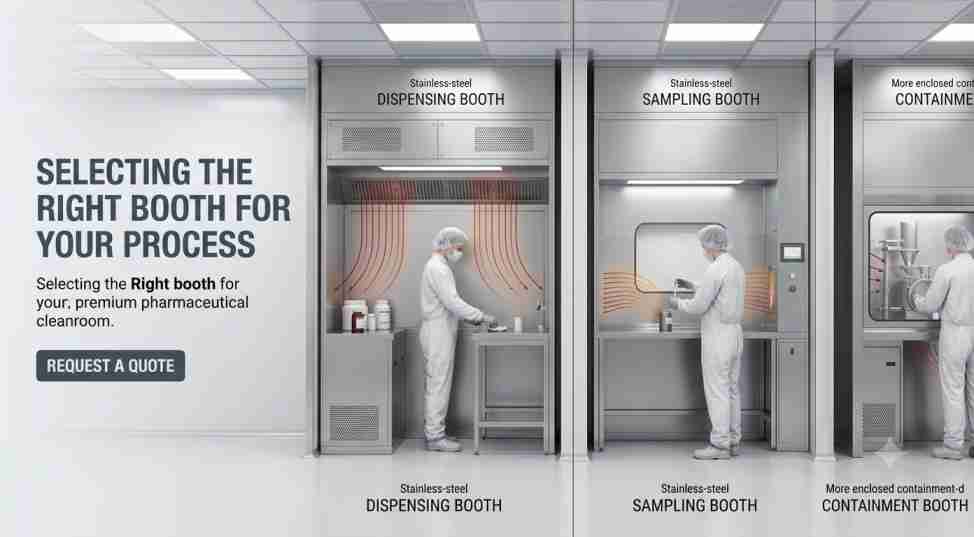
A dispensing booth — sometimes called a weighing booth — provides a localized, negative-pressure work zone with unidirectional laminar airflow for weighing, refilling, and dispensing raw materials or compounds.
Where Dispensing Booths Are Used
Dispensing booths are most common in pharmaceutical manufacturing, where accurate weighing and dispensing of APIs (Active Pharmaceutical Ingredients) and excipients happens repeatedly throughout production. They're also used in biotechnology and fine chemical handling wherever precise, contamination-free material transfer is required before a batch enters production.
Key Features of a Pharmaceutical Dispensing Booth
HEPA-filtered unidirectional downflow, typically maintaining an ISO Class 5-equivalent work zone
Negative pressure design that draws airborne particles inward, away from the operator's breathing zone
SS 304 or SS 316 construction for corrosion resistance and easy decontamination
Differential pressure monitoring, magnetic door interlocks, and alarm indicators as standard controls
Designed to protect both the operator (from hazardous dust exposure) and the product (from cross-contamination)
Sampling Booth: Purpose & How It Works
A sampling booth uses essentially the same reverse laminar airflow technology as a dispensing booth — the distinction is largely about where in the process it's used, not how it's built.
Dispensing Booth vs Sampling Booth: What's the Real Difference?
In practice, dispensing and sampling booths are frequently the same underlying equipment, with the naming simply reflecting the task performed. A dispensing (or weighing) booth is generally used to weigh and dispense batch components during production, while a sampling booth is more often placed in a warehouse or raw material receiving area to draw small samples from incoming materials for quality testing before they're released into the production line.
Where Sampling Booths Are Used
Raw material warehouses, for QC sampling of incoming ingredients before batch release
Quality control labs, where representative samples need to be pulled without introducing contamination
Any point in the supply chain where a small quantity needs to be extracted from bulk packaging under controlled airflow
Containment Booth: Purpose & How It Works
A containment booth is purpose-built around one priority above all others: preventing hazardous or highly potent material from escaping into the surrounding environment, protecting the operator from exposure.
Negative Pressure & Powder Containment Explained
Containment booths rely on a stronger negative-pressure design than a standard dispensing booth, often paired with additional operator protection features (glove ports, PPE stations, or enhanced local exhaust). This is particularly important when handling potent compounds — including certain APIs classified at higher Occupational Exposure Band (OEB) levels — where even minimal airborne exposure poses a health risk to the operator.
Where Containment Booths Are Used
Handling highly potent or hazardous APIs and cytotoxic compounds
Operations requiring compliance with SMEPAC-style containment performance verification
Facilities where operator exposure limits are strictly regulated and must be documented as part of quality and safety audits
Cleanroom Booth Types Compared: Dispensing vs Sampling vs Containment
| Feature | Dispensing Booth | Sampling Booth | Containment Booth |
| Primary purpose | Weighing & dispensing batch components | Sampling incoming raw materials | Handling hazardous/potent compounds |
| Typical location | Production floor / dispensing suite | Warehouse / QC receiving area | Potent compound handling areas |
| Airflow design | HEPA downflow, negative pressure | HEPA downflow, negative pressure | Enhanced negative pressure + containment |
| Operator protection priority | Standard | Standard | Highest — often includes PPE stations/glove ports |
| Cleanroom classification achieved | ISO Class 5-equivalent | ISO Class 5-equivalent | ISO Class 5-equivalent with added exposure control |
How to Choose the Right Cleanroom Booth for Your Facility
Material of Handling — Powders, APIs & Potent Compounds
Start with what you're actually handling. Routine excipient weighing calls for a standard dispensing booth; incoming raw material QC calls for a sampling booth; and any potent or cytotoxic compound handling should be routed to a properly specified containment booth with enhanced exposure control.
Required Cleanroom Classification (ISO Class 5 and Above)
Most booths are designed to maintain an ISO Class 5-equivalent work zone at the point of handling, even when the surrounding room is a lower classification (such as Grade D or ISO Class 8). Confirm what classification your process validation requires at the work surface versus the background room.
GMP Clean Room Equipment Compliance Requirements
For pharmaceutical use, your booth should support GMP clean room equipment compliance — meaning validated airflow patterns, documented differential pressure ranges, and readiness for IQ/OQ/PQ qualification as part of your facility's overall validation package.
Construction Standards: SS 304/316, Modular Design & ISO Certification
Cleanroom booths are typically constructed in stainless steel — SS 304 for general pharmaceutical and industrial use, or SS 316 where frequent exposure to aggressive cleaning agents or corrosive chemicals is expected — with powder-coated panels or toughened glass viewing windows depending on the application.
Modular Clean Room Equipment — Why It's Gaining Preference in India
Modular clean room equipment, including modular booths, is increasingly preferred across Indian pharmaceutical and electronics manufacturing because it allows faster installation, easier relocation, and simpler scaling as production needs grow — without the extended lead times and structural work a permanent build-out requires.
ISO Certified Clean Room Equipment — What to Verify Before You Buy
Before finalizing a supplier, confirm that the booth is genuinely ISO certified clean room equipment — meaning it's been designed and tested to ISO 14644 cleanroom principles, not simply marketed as "cleanroom grade" without supporting documentation. Ask for filtration efficiency data, airflow validation reports, and material certifications.
Why Choose Rayshen as Your Clean Room Equipment Manufacturer
Direct Clean Room Equipment Manufacturer & Supplier in India
As a direct clean room equipment manufacturer and supplier in India, Rayshen Environmental designs and fabricates dispensing, sampling, and containment booths in-house — not through a trading arrangement — giving you full customization on booth size, SS grade, HEPA filter stage, and containment level, along with direct factory pricing and technical support throughout installation and validation.
Clean Room Equipment Exporter — Serving Beyond India
Beyond domestic pharmaceutical and electronics manufacturers, Rayshen also operates as a clean room equipment exporter, supplying booths, pass boxes, and complete cleanroom infrastructure to facilities requiring GMP-aligned equipment outside India.
Frequently Asked Questions (FAQs)
1. What is the difference between a dispensing booth and a sampling booth?
They use the same underlying reverse laminar airflow technology; a dispensing booth is typically used for weighing and dispensing batch components during production, while a sampling booth is more often used for QC sampling of incoming raw materials.2. What makes a containment booth different from a standard dispensing booth?
A containment booth is designed with stronger negative pressure and additional operator protection features specifically for handling hazardous or highly potent compounds where exposure control is critical.3. What cleanroom classification does a booth typically achieve?
Most dispensing, sampling, and containment booths maintain an ISO Class 5-equivalent work zone at the point of handling, regardless of the background room's classification.4. Is SS 316 necessary for a pharmaceutical cleanroom booth?
Not always — SS 304 is standard for most applications; SS 316 is recommended where the booth will face frequent exposure to corrosive chemicals or aggressive sanitization.5. What should I check before buying ISO certified clean room equipment?
Ask for airflow validation reports, HEPA filtration efficiency data, and material certification — genuine ISO 14644-aligned equipment should come with supporting documentation, not just marketing claims.Conclusion
Dispensing, sampling, and containment booths all rely on the same core technology — HEPA-filtered, negative-pressure, unidirectional airflow — but each is tuned for a different point in your material handling process. Choosing the right one comes down to what you're handling, where in your process it happens, and how much operator exposure control your compounds demand.
As a direct clean room equipment manufacturer, supplier, and exporter, Rayshen Environmental builds GMP-compliant, ISO-aligned dispensing, sampling, and containment booths in SS 304/316, with modular configurations available for faster deployment across pharmaceutical, biotechnology, and industrial facilities.
Looking for a Clean Room Equipment Manufacturer in India? Contact Rayshen for a custom quotation, or explore our Clean Room Equipment range directly.
.png)
.png)