Clean Room Equipment 101: HEPA Filters, FFUs, Air Showers, and More
.png)
13-07-2026
Setting up a compliant cleanroom involves far more than four sealed walls and a HEPA-filtered ceiling. It requires a coordinated system of equipment working together to control particulate levels, manage airflow, and maintain the pressure differentials that keep contamination out. For pharmaceutical, semiconductor, hospital, and industrial facilities alike, understanding what goes into a complete clean room equipment package is the first step toward getting a facility that actually performs to its rated classification.
At Rayshen, we work as a direct clean room equipment manufacturer, building HEPA filters, fan filter units (FFUs), air showers, pass boxes, and modular cleanroom furniture for clients across pharmaceutical, laboratory, hospital, and semiconductor industries. This guide breaks down the core categories of clean room equipment, what each component does, and what to look for when specifying or sourcing a system.
What Counts as Clean Room Equipment?
Clean room equipment refers to the full range of engineered components that maintain a controlled environment's classification — air filtration, airflow management, personnel and material transfer systems, and specialized furniture designed for low-particle-shedding environments.
Core Categories of Clean Room Equipment
Air filtration systems — HEPA and ULPA filters, pre-filters, and terminal housings
Airflow equipment — fan filter units (FFUs), laminar flow hoods, and diffusers
Transfer and entry equipment — air showers, pass boxes, and interlocked doors
Furniture and fixtures — stainless steel workstations, garment storage, and cleanroom-rated seating
Monitoring systems — particle counters, differential pressure gauges, and environmental sensors
A well-specified cleanroom integrates all of these elements so that particulate control, pressure cascades, and personnel workflow work together rather than in isolation.
HEPA Filters: The Foundation of Every Clean Room Equipment Package
No discussion of clean room equipment starts anywhere except HEPA filtration. HEPA (High-Efficiency Particulate Air) filters remove at least 99.97% of particles at 0.3 microns — the size range hardest for any filter media to capture — and they form the terminal filtration stage in most cleanroom ceiling grids.
Cleanrooms typically use HEPA grades from H13 to H14 depending on classification requirements, with higher grades reserved for ISO Class 5 and cleaner environments such as aseptic filling lines or semiconductor lithography bays. Filter construction format also matters: mini pleat designs suit high-airflow, space-constrained installations, while deep pleat formats are common in HVAC ductwork and pre-filtration stages.
Fan Filter Units (FFUs): Powering Cleanroom Airflow
A fan filter unit combines a HEPA filter with an integrated fan module, delivering filtered air directly into the cleanroom without relying solely on central air handling. FFUs are the backbone of unidirectional (laminar) airflow cleanrooms and modular cleanroom builds.
Why FFUs Matter in a Clean Room Equipment System
Deliver consistent, filtered airflow at the point of use
Support scalable, modular cleanroom expansion
Reduce dependency on oversized central HVAC systems
Allow zone-specific airflow adjustments for mixed-classification facilities
FFUs are especially valuable in modular clean room equipment builds, where facilities need to expand or reconfigure cleanroom zones without a full HVAC redesign.
Air Showers: Controlling Contamination at Entry Points
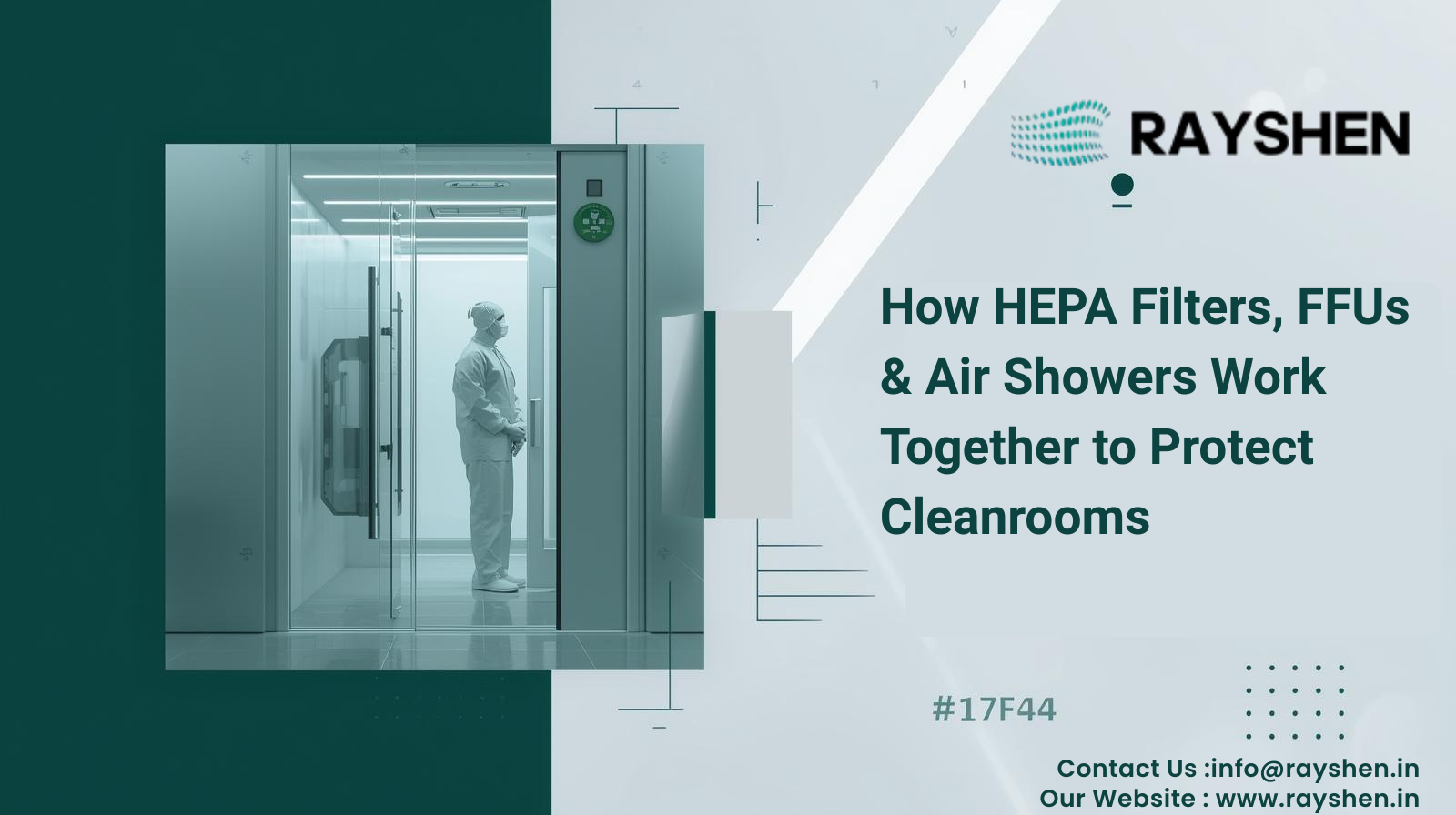
An air shower is a decontamination chamber installed at cleanroom entry points, using high-velocity, HEPA-filtered air jets to remove loose particles from personnel and equipment before they enter the controlled environment. Air showers act as the last line of defense against contamination carried in on garments, packaging, and equipment carts.
Single-person air showers suit lower-traffic facilities, while tunnel-style air showers handle higher personnel throughput in larger pharmaceutical or semiconductor plants. Interlock systems ensure both doors can't open simultaneously, preserving pressure differentials between the gowning area and the cleanroom.
Clean Room Furniture Manufacturer Considerations: Beyond Filtration
Filtration and airflow only address half of the contamination control equation — the furniture and fixtures inside the cleanroom matter just as much. A qualified clean room furniture manufacturer designs workstations, storage units, and seating specifically to avoid particle generation and simplify cleaning validation.
Key Features of Cleanroom-Rated Furniture
Smooth, non-porous stainless steel or powder-coated surfaces
Rounded edges and minimal crevices to prevent particle accumulation
Static-dissipative materials where ESD control is required
Modular designs that allow easy reconfiguration without compromising cleanability
Furniture that isn't purpose-built for cleanroom use — standard laminate desks, fabric-upholstered chairs, or open-frame shelving — can undermine even the best filtration system by continuously shedding particles into the controlled environment.
GMP Clean Room Equipment Requirements for Pharmaceutical Facilities
Pharmaceutical manufacturers face some of the strictest documentation and validation requirements in the industry, and their GMP clean room equipment must be sourced accordingly. Good Manufacturing Practice (GMP) guidelines require equipment that supports:
Validated air change rates and pressure differentials appropriate to the room's classification
Material traceability for filter media, gaskets, and furniture surfaces
Documented cleaning and sanitization compatibility
Equipment design that minimizes microbial harborage points
For pharmaceutical clean room equipment, this typically means stainless steel construction, sealed light fixtures, coved wall-to-floor junctions, and HEPA filtration validated with scan test reports before installation. Working with a manufacturer experienced in pharmaceutical compliance reduces the risk of failed regulatory audits later.
Modular Clean Room Equipment: Flexibility for Growing Facilities
Not every facility can commit to a permanent, hard-walled cleanroom from day one. Modular clean room equipment — including panel systems, FFU ceiling grids, and prefabricated wall units — allows facilities to build, expand, or relocate cleanroom space with far less downtime than conventional construction.
Advantages of a Modular Approach
Faster installation timelines compared to traditional construction
Easier reconfiguration as production needs change
Lower long-term capital cost for facilities anticipating growth
Compatibility with standard FFU and HEPA filter dimensions for simplified future upgrades
Modular systems are increasingly popular among semiconductor and pharmaceutical companies scaling production incrementally, since equipment can be added zone by zone rather than requiring a full facility rebuild.
Choosing a Clean Room Equipment Manufacturer vs Supplier
There's an important distinction between a clean room equipment manufacturer and a general clean room equipment supplier. A manufacturer designs and fabricates equipment in-house — controlling material quality, testing, and customization — while a supplier may simply resell equipment sourced from third parties.
Questions to Ask Before Selecting a Partner
Does the company manufacture HEPA filters, FFUs, and air showers directly, or resell them?
Can they provide test certification (scan test/DOP reports) for filtration products?
Do they offer custom sizing for non-standard installations?
What is their track record supplying pharmaceutical clean room equipment or GMP-regulated facilities?
Are they positioned as a clean room equipment exporter with experience navigating international compliance and logistics?
Working directly with a manufacturer typically means better pricing, faster customization, and more accountability if a component underperforms — since there's no intermediary between the buyer and the production line.
Clean Room Equipment India: A Growing Manufacturing Hub
The clean room equipment India market has expanded significantly as pharmaceutical, semiconductor, and medical device manufacturing has scaled domestically. Indian manufacturers now compete on both quality and cost with established global suppliers, offering:
Locally manufactured HEPA filters, FFUs, and air showers with shorter lead times for domestic clients
Growing capability as a clean room equipment exporter serving Southeast Asia, the Middle East, and Africa
Increasing adoption of ISO certified clean room equipment standards to meet international buyer requirements
For facilities sourcing domestically or regionally, Indian manufacturers offer a compelling balance of cost efficiency, customization flexibility, and improving quality certification standards.
Why ISO Certified Clean Room Equipment Matters
Specifying ISO certified clean room equipment isn't just a compliance checkbox — it's a practical assurance that filtration, construction materials, and testing methodologies meet internationally recognized benchmarks. Certifications relevant to cleanroom equipment include:
ISO 14644 — cleanroom classification and testing standards
EN 1822 — HEPA and ULPA filter efficiency classification
ISO 9001 — manufacturer quality management systems
Facilities that specify ISO-certified equipment reduce audit risk, simplify validation documentation, and gain confidence that equipment performance has been independently verified rather than self-declared by the manufacturer.
Building a Complete Clean Room Equipment Package: A Practical Checklist
When planning a new cleanroom or upgrading an existing one, use this checklist to make sure no equipment category gets overlooked:
Filtration — HEPA/ULPA filters sized and graded to the room's ISO classification
Airflow — FFUs or laminar flow hoods matched to required air change rates
Entry control — air showers, pass boxes, and interlocked doors at all transfer points
Furniture — cleanroom-rated workstations, storage, and seating from a qualified manufacturer
Monitoring — particle counters and pressure differential gauges for ongoing validation
Documentation — test certificates, material traceability, and ISO compliance records from your supplier
Conclusion
Clean room equipment is a system, not a single product — HEPA filters, FFUs, air showers, and purpose-built furniture all need to work together to deliver a facility that consistently meets its classification. Whether you're building a new pharmaceutical suite, expanding a semiconductor fab, or setting up a modular lab cleanroom, the equipment decisions you make upfront determine long-term performance, compliance, and cost of ownership.
As a manufacturer of HEPA filters, FFUs, air showers, and modular cleanroom equipment, Rayshen supports clients across pharmaceutical, industrial, laboratory, and semiconductor sectors with both standard and custom-engineered solutions built to ISO-certified standards.
.png)
.png)