What Is an Air Shower? How It Works and Why Every Cleanroom Needs One
11-05-2026
In the high-precision world of pharmaceutical manufacturing, semiconductor fabrication, and biotechnology, the greatest threat to product integrity isn't the raw materials or the machinery—it is the human operator. Even with the most stringent gowning protocols, the human body is a "particle engine," shedding millions of skin cells and microorganisms every hour.
To bridge the gap between the uncontrolled "gray zone" and a sterile clean room, industry leaders rely on the Air Shower. This guide provides a 2,000-word deep dive into why this piece of clean room equipment is the most critical investment for your facility’s contamination control strategy.
1. Defining the Air Shower: The Gateway to Purity
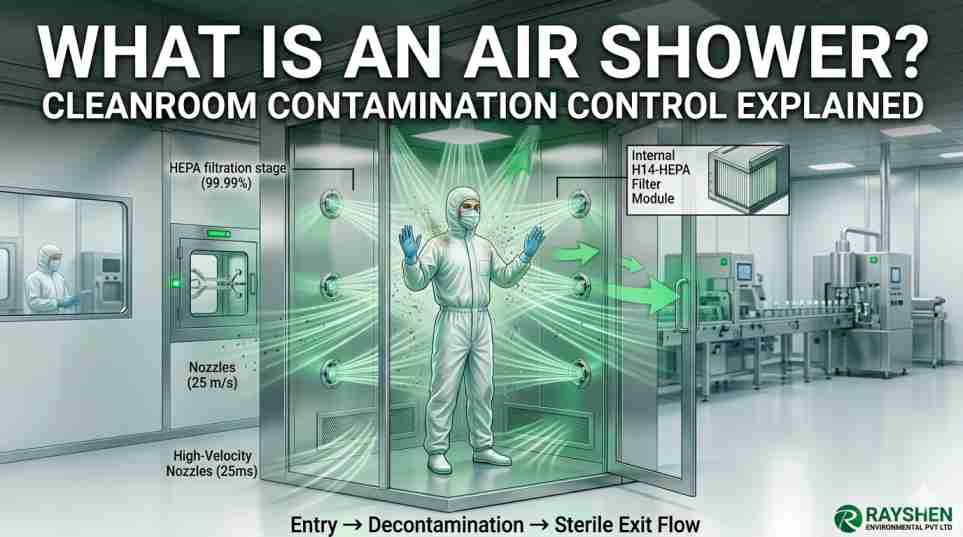
An Air Shower is a specialized, self-contained chamber that uses high-velocity, HEPA-filtered air to remove loose contaminants from personnel and equipment before they enter a clean room. It acts as a pressurized buffer, ensuring that the transition into a controlled environment does not compromise the air quality.
Whether you are operating a large-scale modular cleanroom booth or a small portable cleanroom enclosure, the air shower serves as the final "scrubbing" stage that guarantees your ISO Class 5 Clean Room stays within its particulate limits.
2. How an Air Shower Works: The Science of Decontamination
The effectiveness of an air shower is not based on simple fans; it is based on advanced fluid dynamics.
High-Velocity Air Jets
The heart of the unit is a system of adjustable stainless steel nozzles. These nozzles blast air at velocities ranging from 20 to 25 meters per second (m/s). This velocity is calculated to create enough kinetic energy to dislodge sub-micron particles that are trapped in the fibers of cleanroom garments or on the surface of equipment.
The Filtration Cycle
The air used in the shower is continuously recycled through a two-stage filtration process:
Pre-Filtration: Large dust particles are trapped by a G4 or F7 grade pre-filter to protect the expensive secondary filter.
HEPA/ULPA Filtration: The air is then forced through a HEPA filter (99.99% efficiency at 0.3μm), ensuring that the air hitting the operator is ultra-pure.
The Interlocking Mechanism
To prevent cross-contamination, air showers utilize an electronic interlocking door system. This ensures that the cleanroom door cannot be opened until the "shower" cycle is complete and the entry door is securely locked. This prevents a "chimney effect" where outside air could be sucked into the sterile zone.
3. Why Every Cleanroom Needs an Air Shower
Preserving ISO Class 5 Clean Room Integrity
In an ISO Class 5 Clean Room, you are allowed no more than 3,520 particles (0.5µm) per cubic meter. Without an air shower, a single person entering the room can spike that count into the millions for several minutes. The air shower ensures the "recovery time" of the cleanroom is kept to a minimum.
Reducing Strain on Fan Filter Units (FFUs)
By removing 80-90% of surface contaminants at the entrance, you significantly reduce the dust load on your ceiling-mounted FFUs. This extends the life of your internal HEPA filters by years, drastically reducing your long-term maintenance costs.
Personnel Discipline and Compliance
The physical act of stepping into an air shower reinforces the importance of contamination control to your staff. As a cleanroom booth manufacturer, Rayshen has observed that facilities with air showers have 30% higher adherence to overall gowning protocols compared to those without them.
4. Modular Cleanroom Booth vs. Softwall Solutions
When planning your facility, the type of air shower you choose depends on your structural needs.
Modular Cleanroom Booth Integration
For permanent pharmaceutical or micro-electronic plants, air showers are integrated into the modular cleanroom booth structure. These are often made of Stainless Steel (SS304) to withstand heavy traffic and rigorous chemical washdowns.
Softwall Cleanroom Considerations
Many startups and research labs look at the softwall cleanroom price and assume they can skip the air shower. However, softwall environments are more susceptible to external pressure changes. Adding a specialized air shower tunnel to a softwall setup can elevate its performance to a hardwall standard at a fraction of the cost.
Portable Cleanroom Enclosure
For localized manufacturing (like 3D printing or medical device assembly), a portable cleanroom enclosure with a built-in mini-air shower provides a "plug-and-play" solution that can be moved as production needs change.
5. Technical Specifications: What to Look for in a Manufacturer
Choosing a cleanroom booth manufacturer requires looking beyond the price tag. You must evaluate the engineering quality.
Material of Construction: Always opt for SS304 or SS316L. Powder-coated steel is prone to chipping and rusting over time.
Nozzle Configuration: Look for units with nozzles on all three sides (left, right, and top) to ensure a 360-degree clean.
PLC Control Systems: Modern units should have programmable logic controllers to adjust shower time (typically 12–15 seconds) and lighting delays.
Emergency Features: Every air shower must have an internal emergency release button to bypass the locks in case of power failure or fire.
6. The Economic Impact: ROI of the Air Shower
While the initial cost might seem high, the Return on Investment (ROI) is realized through:
Batch Protection: One contaminated batch in pharma can cost hundreds of thousands of dollars. An air shower is an insurance policy against that risk.
Energy Savings: Cleanroom FFUs don't have to work as hard when the particle load is lower, leading to lower utility bills.
Lower Filter Replacement Costs: A HEPA filter replacement for a 2x4 FFU is expensive. By protecting them with an air shower, you double their lifespan.
7. Maintenance and Validation
To keep your air shower functioning as part of your clean room equipment arsenal, regular validation is required:
Air Velocity Testing: Ensure nozzles are still hitting the >20 m/s threshold.
Particle Count Testing: Validate that the HEPA filter inside the air shower hasn't developed leaks.
Sensor Calibration: Ensure the auto-start sensors detect personnel accurately to avoid "skipped" cycles.
Conclusion: Partner with a Leading Cleanroom Booth Manufacturer
The air shower is the silent guardian of your cleanroom. It is the bridge between the world of contaminants and the world of precision. Whether you are concerned about the softwall cleanroom price or looking to build a state-of-the-art ISO Class 5 Clean Room, Rayshen has the engineering expertise to protect your investment.
Ready to Secure Your Cleanroom?
Rayshen provides end-to-end air filtration and cleanroom solutions. From high-velocity air showers to modular enclosures, we ensure your facility meets global standards.
[Contact Rayshen Today for a Custom Quote on Cleanroom Equipment]
6 Frequently Asked Questions (FAQs)
1. Can an air shower be used for equipment as well as people?
Yes. Large-scale modular cleanroom booths often use "Cargo Air Showers" specifically designed for pallets and carts to ensure that raw materials don't bring dust into the sterile zone.
2. Is it difficult to integrate an air shower into an existing softwall cleanroom?
Not at all. Rayshen designs specialized tunnels that can be docked to any softwall setup. This is a common way to upgrade a facility's cleanliness without a full rebuild.
3. How often should the filters in the air shower be replaced?
The pre-filters should be replaced every 3–6 months. The main HEPA filters inside the unit typically last 2 years, depending on the frequency of use.
4. Does an air shower eliminate the need for gowning?
No. An air shower is a supplement to, not a replacement for, proper gowning. It removes the particles that settle on the cleanroom suit during the gowning process.
5. What makes a "Portable Cleanroom Enclosure" different?
A portable cleanroom enclosure is usually smaller and on wheels. The air shower integrated into these units is optimized for quick entry and exit in rapid-deployment environments.
6. What is the typical softwall cleanroom price with an air shower included?
Prices vary based on size and ISO class, but adding an air shower generally increases the total project cost by 15-20%. However, this is offset by the significantly lower maintenance and filter replacement costs over time.
.png)
.png)