Air Shower for Cleanrooms: Working Principle, Types, and Selection Guide
18-08-2026
Every cleanroom is only as clean as its weakest entry point. No matter how effective your HEPA filtration or laminar airflow system is, personnel and materials moving in and out of the controlled space carry particulate contamination on clothing, skin, and equipment surfaces. This is precisely the problem an air shower is engineered to solve.
This guide explains what an air shower is, how it functions as a critical contamination control checkpoint, the different configurations available, and what to evaluate before specifying one for your facility.
What Is an Air Shower?
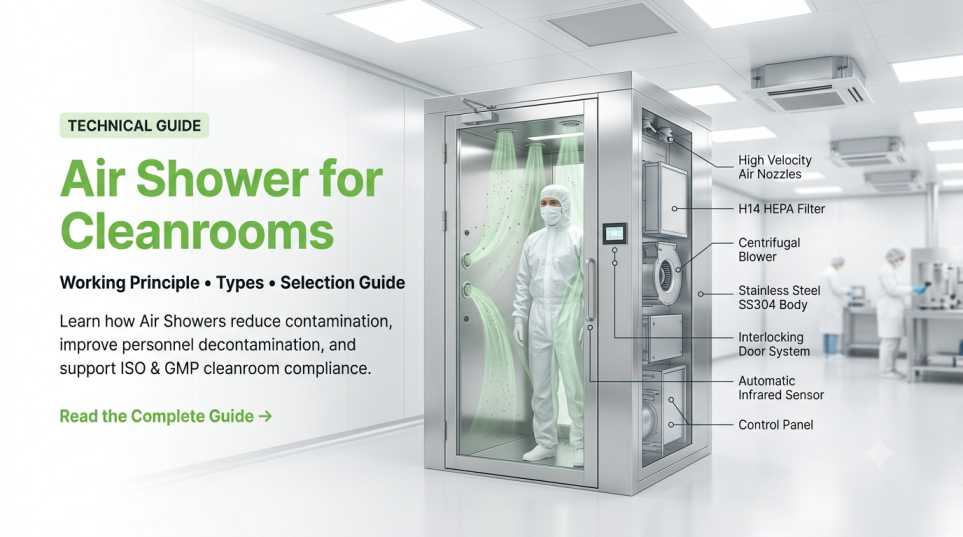
An air shower is an enclosed chamber installed at the entry point of a cleanroom that uses high-velocity, HEPA-filtered air jets to dislodge and remove loose particulate contamination from personnel or materials before they enter the controlled environment. Positioned as a mandatory transition zone between a gowning area and the cleanroom proper, air showers act as the final decontamination checkpoint in a facility's contamination control strategy.
Unlike a simple air curtain or pass-through, an air shower is an active decontamination system — high-pressure nozzles direct filtered air at specific angles across the body or material surface for a set duration, physically blasting loose particles off before they can be carried into the clean zone.
How an Air Shower Works
The air shower cycle follows a defined sequence:
Entry and interlock activation – The person or material enters the chamber, and the interlock door system ensures both doors cannot be open simultaneously, preventing unfiltered air exchange.
HEPA-filtered air circulation – Air is drawn through a HEPA filter (typically H13 or H14 grade) and pressurized through a network of nozzles.
High-velocity jet blast – Nozzles direct air at high velocity (typically 20-30 m/s) from multiple angles, dislodging particulates from clothing, hair, and exposed skin.
Timed cycle completion – The shower cycle runs for a pre-set duration (commonly 15-30 seconds), after which the exit door unlocks, allowing entry into the cleanroom.
Interlock Door Systems
The interlock door system is a critical safety and contamination-control feature of any air shower. By ensuring only one door can open at a time, it prevents unfiltered corridor air from bypassing the shower cycle and entering the cleanroom directly — a failure point that would otherwise undermine the entire purpose of the unit.
Types of Air Showers
Personnel Air Showers
Designed for single or multiple occupants, these units are sized to accommodate one to several people per cycle and are the most common configuration in pharmaceutical and electronics cleanrooms.
Cargo / Material Air Showers
Larger units designed to decontaminate equipment, tools, and material carts before they enter the cleanroom. These typically feature wider chamber dimensions and reinforced flooring to accommodate wheeled equipment.
Corner and Straight-Through Configurations
Air showers are available in straight-through designs (entry and exit on opposite sides, suited for linear gowning-to-cleanroom flow) and corner/L-shaped designs (entry and exit at 90 degrees, useful where facility layout constraints limit straight-line installation).
Why Air Showers Are Critical Across Regulated Industries
Pharmaceutical Manufacturing
GMP-compliant pharmaceutical facilities use air showers as a mandatory gowning-to-cleanroom transition step, reducing the bioburden and particulate load personnel introduce into sterile and non-sterile manufacturing zones.
Semiconductor and Electronics
In ISO Class 5 and cleaner semiconductor fabs, even minor particulate contamination carried in on clothing can cause wafer-level defects. Air showers here often run longer cycle times and higher jet velocities than standard configurations.
Hospitals — OT and CSSD
Surgical and sterile processing areas use air showers to minimize contamination risk before staff enter operation theatres or Central Sterile Supply Departments, supporting infection control protocols.
Biotechnology and Laboratory Environments
Research and biosafety facilities use air showers both to protect sensitive experiments from external contamination and, in some configurations, to help contain material moving out of controlled zones.
Food Processing
Food manufacturing facilities increasingly install air showers at production entry points to reduce microbial and particulate contamination risk in packaging and sensitive processing areas.
Key Design Factors in Air Shower Specification
Nozzle Configuration and Airflow Velocity
Nozzle count, angle, and placement determine how effectively the unit reaches all body surfaces. Adjustable or rotating nozzles improve coverage compared to fixed configurations.
HEPA Filtration Grade
Most air showers use H13-grade HEPA filtration for the recirculated air stream, though H14 may be specified for higher-classification cleanrooms requiring tighter contamination control.
Cycle Time and Control Options
Standard cycle times range from 15-30 seconds, though facilities can typically customize this based on throughput needs and contamination control requirements. Sensor-activated cycles (rather than manual button start) improve compliance and reduce bottlenecks at shift changes.
Chamber Size and Occupancy
Single-person, multi-person, and cargo-sized chambers should be selected based on facility throughput and material handling needs — undersized units create bottlenecks during shift changeovers.
The Direct Manufacturer Advantage
Sourcing air showers from a direct manufacturer rather than a trading company provides meaningful advantages for regulated facilities:
Factory-tested airflow performance: Nozzle velocity and HEPA filter integrity are verified before dispatch, ensuring consistent decontamination performance from day one.
Customization capability: Chamber dimensions, nozzle configuration, interlock control logic, and finish materials (stainless steel, powder-coated GI) can be built to project specifications.
Full documentation support: Complete IQ/OQ/PQ validation documentation is provided to support facility qualification and regulatory audits.
Direct factory pricing: Eliminating reseller markups makes multi-unit or project-based procurement significantly more cost-effective.
As a direct manufacturer, Rayshen Environmental fabricates air showers in-house — from chamber construction and interlock system integration to HEPA filter installation and final performance testing — giving buyers complete traceability over the unit they receive.
How to Choose the Right Air Shower
Facility throughput – Estimate peak personnel and material flow to size chamber occupancy correctly.
Cleanroom classification – Higher ISO classifications generally warrant higher-grade HEPA filtration and longer cycle times.
Layout constraints – Choose straight-through or corner configurations based on available gowning-to-cleanroom pathway space.
Interlock and control requirements – Confirm compatibility with existing access control or BMS systems if integration is required.
Documentation needs – Regulated industries should confirm IQ/OQ/PQ and validation documentation are available from the manufacturer before procurement.
Air Shower Maintenance and Testing
To sustain decontamination performance over the unit's operational life, facilities should implement:
Periodic HEPA filter DOP/PAO leak testing to confirm filtration integrity
Nozzle inspection and cleaning to prevent airflow obstruction or uneven jet distribution
Interlock mechanism testing to confirm door sequencing continues to function as designed
Airflow velocity verification to ensure jets maintain sufficient force for effective particulate removal
Conclusion
An air shower may be one of the smaller footprint elements within a cleanroom facility, but its role as the final contamination checkpoint before entry makes it disproportionately important to overall contamination control strategy. From pharmaceutical gowning rooms to semiconductor fab entries and hospital OT corridors, correctly specifying chamber size, nozzle configuration, and filtration grade directly impacts how effectively a facility protects its controlled environment.
As a direct manufacturer of air showers in India, Rayshen Environmental builds HEPA-filtered, interlock-controlled air showers with customizable configurations and complete IQ/OQ/PQ documentation — supporting pharmaceutical, semiconductor, healthcare, and food processing customers with factory-tested performance.
Planning a cleanroom entry point upgrade? Reach out to Rayshen Environmental's technical team for air shower specifications, layout recommendations, and a detailed project quotation.
Related post
- Air Shower vs. Pass Box: What's the Difference and When Do You Need Each?
- The Ultimate Guide to Cleanroom Air Showers: Maximizing Contamination Control and GMP Compliance
- The Secret to Zero-Batch Failure: Why Air Showers are the Ultimate ROI for Pharma Cleanrooms
- Beyond the Blower: A Technical Buyer’s Guide to Selecting Industrial Air Showers
- Eliminating Cleanroom Contamination: Why Air Showers are the Secret to Zero-Batch Failure
- Air Shower Systems: Advanced Contamination Control for Modern Clean Room Environments
.png)
.png)